



Beer Marketer's Insights
PROFILE: Brain-Boosting Koios Canned Nootropics Build on Walmart, GNC Presence; DSD Likely Next Step
Can nootropics really become a thing? Denver-based co called Koios Beverage claims to be receiving encouraging early signals for its canned Koios line, which early in its life cycle has won a spot in Walmart and is claimed to be moving briskly in nutrition retailers like GNC and fitness channel.
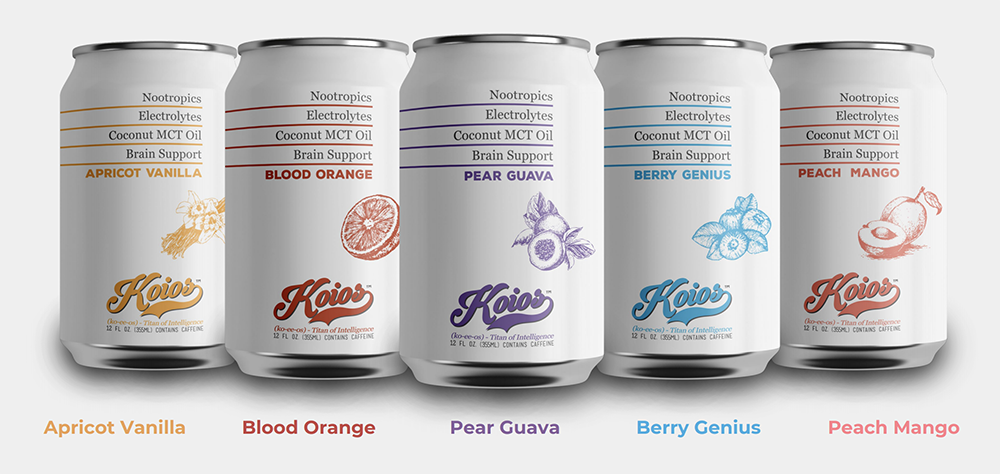
Koios line contains nootropic and “brain support” ingredients like lion’s mane and chaga mushrooms, alpha GPC, ciwujia (eleuthero root), GABA, L-theanine and L-tyrosine as well as electrolytes, B-vitamins and coconut MCT oil. Premise is that ingredients like these improve cognitive abilities by increasing blood flow to brain and oxygen levels and strengthening neural connections. Koios is out in Pear Guava, Blood Orange, Peach Mango, Apricot Vanilla and Berry Genius flavors. It goes out at aggressive price of $2.50 per 12-oz can in Walmart, $3.25 in fitness channel, thanks to self-production scheme out of pair of plants in Denver with capacity to do 10K cases per week, founder/ceo Chris Miller told us recently. Brand is named for Greek titan associated with intelligence, as can copy explains.
Miller believes that just as kombuchas began to flourish a decade ago as consumers began to worry more about their bodies, nootropics are about to have their day as the brain becomes next frontier. Why? Because brains haven’t evolved to keep up with technology that leaves many of us distracted, anxious, depressed. Caffeine helps a bit, but that’s “old technology,” Chris argues. (Koios does contain mild dose of 60 mg of stimulant.) Enter nootropics, which have begun to percolate in market. In NY, Kin Euphorics launched by Soylent cofounder just added single-serve option to its shots dispensed from multiserve bottles (BBI, Mar 27 and Jul 8) while in Atlanta recently we encountered 16-oz canned item called Euphoria Mood Enhancer from marketer of kratom-based and other products called The Joint Drink Co whose front panel promises “unbelievable happiness with nootropics.”
Miller readily acknowledges that his first foray into space in 2016 was a fiasco, thanks to over 2,000 mg of active ingredients including MCT oil. So, in account that bears resemblance to how Body Armor segued from bad-tasting “super drink” containing dozens of active ingredients to palatable sports drink with short list, Koios stripped formula down to essence, using natural sweeteners to come in at just 10-20 calories per can (from the MCT oil). Revamped entry had first production in summer 2018 and went DTC at first. Within 4 months, he said, it had been approached by Walmart and this past Mar it went national within GNC nutrition chain. By now it’s in over 4K retail doors. That and DTC base has awakened interest of DSD distributors in major metros, with some commitments possible soon, Miller indicated.
Miller claims history of entrepreneurial ventures since graduation from college in 2003, tho profiles on website and LinkedIn don’t specify any by name. On website, his advisory board includes bev hand Chris Koons, who’s been involved with ventures like Rocky Mountain Soda, Dram Drinks, Tub Gin and DSTILL craft spirits fests. Co trades publicly on pink sheets and Canadian exchange via backdoor merger with entity called Super Nova Petroleum Corp but hasn’t reported much financial data since revamped Koios line went into market. Info at KoiosBeverageCorp.com.
Fermented Sciences has landed another $25 mil in growth capital as it expands its fermentation plant at its Ventura, Calif, hq, begins to crack major retail chains with its Flying Embers hard kombucha and prepares addition of a better-for-you beer line next spring. Tho Fermented Sciences operates so far exclusively in alc space via line of hard kombuchas ranging from 4.5% to 7% ABV, founder Bill Moses is familiar figure to BBI readers from his run launching KeVita probiotic brand and exiting to PepsiCo. He’s following similar playbook on alc side now, tho as he readily acknowledged to us in discussion this morning, alc space “is a streetfight – way harder than non-alc was.” Of course, he’s operated for a long time in alc space via his Casa Barranca winery, but wine has very different dynamics than RTD side. Among seasoned team Moses has assembled are 24-year Diageo vet Ty Gilmore, who joined as prexy last month, and Canarchy Craft Brewery Collective marketing vp Kyle Ingram, who’s just coming aboard. We offer deep dive here of brand that’s generated some buzz at nexus of alc and NA spaces.
The Series B round was co-led by Ecosystem Integrity Fund, which had been first institutional partner for KeVita, and PowerPlant Ventures, fund set up by Zico Coconut Water founder Mark Rampolla, who’s co-invested with Moses on several startup brands and sits with him on several boards. Sustainability-focused EIF just closed on 3d round to tune of $100 mil in commitments. PowerPlant’s other investments include Beyond Meat, Ripple Foods, Rebbl, Nutriati and Vive Organic. Also in mix are Blueberry Ventures, which often invests alongside PowerPlant, and Monogram Capital Partners, which had banked craft brewer Saint Archer. Conspicuously absent is KarpReilly, which enjoyed lucrative exit from KeVita and has invested with Bill in bev brands like Koia and Iconic, but Moses said it stayed on sidelines because its extensive restaurant holdings make it wary of violating tied-house laws governing alc brands. Both the Series A and B rounds were assisted by Whipstitch Capital, whose principals played key role in funding KeVita and generating sale to PepsiCo.
By now Flying Embers is moving thru 70 distributors in 32 states, per Bill, and is believed to be well on way toward $10 mil in annual sales. Brand has cracked natural food chains like Whole Foods and Earth Fare, entered Costco’s Calif stores and just added first conventional grocer, Giant Eagle, with numerous other authorizations anticipated in coming weeks, thanks in large part to recruitment last month of Diageo vet Gilmore as prexy. At KeVita, Bill noted, Giant Eagle proved crucial partner in proving that kombucha could resonate in heartland markets outside major coastal enclaves, a role he’s hoping it can play for Flying Embers. (Name, if you’re wondering, was adopted from wildfires raging around Ventura location as Embers set up operations; that issue clearly ain’t going away, and brand contributes 1% of revs to orgs supporting first-responders.)
Moses said Flying Embers ride has had its surprises, with early adopters aligning well with high-end craft drinkers, not necessarily what he’d hoped for in overcrowded segment that’s undergoing a shakeout. Work with Numerator consumer insights firm indicates that hi-alcohol crafts are still resonating while White Claw and other hard seltzers are dominating growth at lower-alc end, so better-for-you message is going to take some time on education end for nutritionally complex hard kombucha that employs adaptogen root blend. While co has been spending ahead of its anticipated growth on extensive national support team, it’s content for now to seek out smaller success stories, “given the show-me attitude” in trade.
Some of new money will go toward that, but it’s also being committed to mfg operation capable of doing wide range of fermented products while avoiding cross-contamination among different yeast strains. Production is sited in 50K-sq-ft plant with adjacent space of similar size available for expansion. Overseeing buildout is Nate Patena, who built out KeVita plant that Pepsi acquired and replicated on East Coast, before heading for stint at Core Nutrition and hanging out his shingle this past spring as Red Decimal.
From start, Fermentation Science has made it clear it intends to enter range of product categories, and next one will be better-for-you beer line reinforced with ingredients like probiotics and reishi mushrooms, due next spring under brand name still being decided. Helping work out branding and positioning issues is another new recruit, Kyle Ingram, whose run at Canarchy included such launches as Oskar Blues’ Wild Basin Boozy Sparkling Water.
Deal we’d teased a coupla weeks ago has crossed finish line: private-equity player First Beverage Group has taken plunge into cannabis space with investment in Mad Tasty brand created by OneRepublic singer/songwriter Ryan Tedder. Deal unites Tedder’s longstanding interest in CBD – he’s long-time friends with Charlotte’s Web founders – with operational and financial expertise of FBG, whose partner Jack Belsito has been acting as Sherpa in buildout, and influence of Interscope Records, OneRepublic’s label and a partner in deal. Financial details weren’t disclosed but Jack told us FBG took its customary position as engaged minority investor. While he’s been making rounds of retailers and distributors with Mad Tasty principals in recent months, he said co is in hunt for coo to take day-to-day reins. We’d reported on FBG’s connection to brand a month ago (BBI, Oct 21).
In discussion yesterday afternoon, Belsito said First Bev had approached Interscope about collaborations on behalf of some of its existing portfolio brands like Health-Ade Kombucha but none had really clicked until Interscope suggested its partnership with Tedder on MadTasty brand. That’s clearly been passion project of Tedder: besides having long awareness of CBD benefits via his friendship with Charlotte’s Web principals, he’s been battling anxiety and panic attacks for past coupla years and was seeking way to make hemp extract more palatable as a daily bev regimen. Combo of Tedder as a bright visionary, in Belsito’s phrase, and terrific brand, great taste and Interscope involvement made it appealing to First Bev as entrée to cannabis sector, after being approached by many other players. Resulting line contains no sugar or sweeteners and boasts 20 mg of broad-spectrum hemp extract via co called Sorse that converts CBD, terpene and hemp oils into water-soluble emulsions. Mad Tasty is out in 2 flavors, Grapefruit and Watermelon Kiwi.
So far Mad Tasty has focused on its SoCal backyard via DSD partner LA Distributing but it recently added Dynamo DSD house in Austin and other parts of south Texas and likely will target Colo next, Belsito indicated. But co will go slow as it waits for retail chains to come off the sidelines, he emphasized.
Acquisitive Dutch-based Refresco Group, which dramatically increased US footprint via Cott deal last year, has added Tempe-based Arizona Production & Packaging (AZPack) to its network of 27 N American plants. Besides augmenting presence in SW part of US, AZPack brings “expertise in manufacturing complex niche products for branded beverage companies,” said Refresco ceo Hans Roelofs. AZPack cofounders Peter Reilly and Yibing Wang will stay aboard. AZPack’s 240K-sq-ft plant in Tempe offers coldfill, hotfill and flash pasteurization process and is capable of producing 400K bottles and 1 mil cans daily, per website.
Roar Organic, which has been building out methodically as low-sugar hydration option targeting young women who’re out to accomplish things in life, is entering the powder segment with single-serve sticks available on Fri. Roar Organic Electrolyte Powder Sticks include similar mix of electrolytes, antioxidants and B-vitamins as RTD line, coming in at just 2 g of sugar (10 calories) via similar sweetener blend of cane sugar, erythritol and stevia. Rival brands, noted cmo Eric Berniker, often contain 6-11 g of sugar. The sticks are launching on RoarOrganic.com and Amazon in Cucumber Watermelon, Mango Clementine and Blueberry Acai flavors, priced at $24.99 per 14-unit pouch, or $1.78 per stick, vs $2-2.50 for bottled version. Subscriber discounts and other inducements would lower that a bit.
Launch closes out eventful year for brand that, under current exec team, took step by step approach to upscale package, revamp website and develop positioning as lifestyle refresher that empowers female “hustlers” (in entrepreneurial and self-realizing senses of word). Early evidence is that plan is panning out, with co’s internal research suggesting that 71% of brand’s volume is incremental to advanced-hydration category, a figure that Berniker feels should be pleasing to retailers’ ears. In about 10K retail doors so far, brand is demonstrating accelerating velocities that place it past Core, Gatorade Bolt, Zico and other natural brands in some accounts. Safeway quadrupled velocity while bringing on 1K additional stores, and co is aiming to add 7K more doors next year. To date, its only DSD partners are Dora’s Naturals in NY and LA Distributing in LA, tho “we believe in DSD” and more houses are likely to enter mix in 2020. Bottled Roar line comprises 6 flavors currently, with top 3 sellers selected for powder extension. As brand expands, Roar is seeking head of sales.
On marketing front, brand this year enlisted cohort of “Roar models,” so far all female, who serve as role models for energetic, primarily female target. By now brand has built influencer base with roughly 3 mil social media followers, and is finding creative ways to active concept. For instance, it recently held panel hosted by The Hurdle podcaster in which Roar models shared their stories. Chance at on-site mentorship drew over 5K entries – no mean feat, considering that applicants had to write essay.
Todd Berardi, who steadfastly built Hiball organic energy brand for a decade with minimal funding with his wife Alyssa Warnock and partner Dan Craytor, is formally exiting co acquired by Anheuser-Busch InBev in summer 2017. Todd’s departure was flagged on his LinkedIn page; he told us he’s taking rest of year off and will plot future steps in new year. No immediate word on whether he’s constrained by non-compete from new bev venture. In recent months he wasn’t believed to have been heavily involved in the day-to-day at brand, which has struggled within ABI system at time that energy biz is being disrupted not so much by natural and plant-based brands like Hiball as by new crop of so-called fitness brands led by Bang. Word of his departure came as ABI cmo Marcel Marcondes made extensive innovation presentation at Beer Marketer’s Insights conference in NY that included not a single mention of NA segments or brands; fielding an audience question about NA strategy, Marcel took it to mean NA beers and said co is “figuring out some minor details, looking for the right angle” and would have more to say early next year. But at least before that audience of beer execs and wholesalers, NAs didn’t seem to be priority . . . Wells Fargo analyst Bonnie Herzog heads over soon to Goldman Sachs, replacing longtime bev analyst Judy Hong. (We hear one destination may be job running investor relations for cannabis player Canopy. That’s career path already trod by former Stifel analyst Mark Swartzberg a year ago via move to IR job at Molson Coors.) At Wells Fargo, Bonnie had developed rep as Wall Streeter unusually close to fundamentals of biz, in part via extensive quarterly survey of c-store buyers. Meanwhile, another longtime bev analyst, Caroline Levy, is evaluating next career move after Macquarie decided to close its research operations. She’d been there two and a half years after a few years at CLSA. That seems unusual degree of flux among cadre of top bev analysts that’s mostly remained very consistent over the years, tho affiliations sometimes shift.
Not long ago associated exclusively with dairy-based yogurt, Chobani formally announced extensive push into oat-based bevs that it had teased last spring at Natl Restaurant Assn show in Chicago. Throw in line of dairy-based creamers and yogurt-with-oats blend and it’s biggest product expansion ever undertaken by Norwich, NY-based co, which has been seeing its sales growth plateau in competitive Greek-style yogurt segment. “I always knew our journey from yogurt to becoming a modern food company would be through nutritious, delicious, batch-made products like Chobani Oats, and today they're helping us further deliver on our founding mission of making better food for more people,” said founder/ceo Hamdi Ulukaya, 47, who recently discovered that he’s become lactose-intolerant as he heads into middle age, per Fast Company profile. Press release emphasized that new platform “isn’t meant to be a replacement for dairy as, for most, it’s not an either/or world between dairy and non-dairy products.” Chobani is self-producing the oat entries in $50 mil expansion to its plant in Twin Falls, Idaho, per Fast Company.
The raft of new entries includes Chobani Oat Drinks packed in 52-oz cartons at $3.99 in Plain, Vanilla, Chocolate, and Plain Extra Creamy versions as well as Chobani Oat Drink Barista Blend designed to froth well in lattes and other coffee drinks. (Ulukaya told Fast Company that the La Colombe coffee chain, in which he holds controlling stake, will cut over from Oatly to Chobani entry in new year.) On yogurt side it’s adding 4-flavor Chobani Oat Blend and 3-flavor Chobani Oat Blend with Crunch, both lines packed in 5.3-oz cups priced at $1.99. As reported last spring (BBI, May 20), at restaurant show co had sampled mockups of barista-oriented oatmilk in gable-topped 32-oz cartons that staffer indicated was targeting fall ship date, meaning sked slipped a wee bit.
On dairy side, it’s adding Chobani Coffee Creamers in 24-oz bottles at $3.99 in Caramel, Sweet Cream, Hazelnut, and Vanilla as well as Chobani Greek Yogurt with Oatmeal.
Nestle Waters North America, seeking added growth avenues, has quietly begun picking up outside bev brands to ride aboard its massive Ready Refresh home & office delivery fleet. First aboard is Vita Coco coconut water brand, but we’re hearing several other names in queue between now and spring, tho their execs have asked us to stay mum until items are closer to hopping aboard the trucks. Given reach of operation, Ready Refresh represents appealing distribution option for brands that NWNA views as complementary to the 3- and 5-gal jugs and multipacks of its Pure Life, Poland Spring, Ozarka, Pellegrino and other bottled-water brands.
Ready Refresh has long carried non-water items ranging from breakroom supplies like paper plates and cups to Starbucks K-Cups, Coffeemate creamer and Nestle hot chocolate, but this would seem to be first time in a while that it’s carrying outside RTDs, and first non-water RTDs since days it owned Sweet Leaf and Tradewinds RTD tea brands, which have since been divested. Website at ReadyRefresh.com has added new page titled “Other Cold Drinks” that so far features just a pair of Vita Coco PET-bottle brands, notably 12-pks of half-liter bottles of its core line and Pressed extension, but other brands are coming. A NWNA rep reached today said she couldn’t yet disclose what other brands are in queue, but said unit is “always exploring new ways to serve our customers,” including looking beyond existing portfolio. As measure of reach of Ready Refresh, she said it has capability of serving over 80% of US population. Its reach just grew another increment this week with acquisition of indie HOD player on NJ shore.
In presentation to Beverage Digest’s Future Smarts conference 3 years ago, then-ceo Tim Brown had described HOD operation as “our lead strategy,” citing burst of growth as century- old biz proved to be in tune with direct-to-consumer and e-commerce waves. (BBI, Dec 13, 2016.) At time he said NWNA delivered to 800K homes, figure that was growing by 100K homes per year.
Core Water Exits Big Geyser Another brand that Big Geyser was crucial in incubating – Core Hydration – is exiting for larger system operated by acquiring co. Keurig Dr Pepper, which acquired Core Water and its extensions in past year, is transitioning to KDP-owned NY house, once known as Mr Natural. Core, recall, was created by Lance Collins, whose Fuze and Body Armor drinks the house has also played a key role in developing. Fuze went over to acquirer Coke a long time ago, but Body Armor – also acquired by KO – has remained in the house. Core exit leaves Geyser riding hot alkaline water brand, Essentia, as well as Hint essence water and flock of sparklers like its own Hal’s Seltzer and Spindrift. No word yet on more mainstream successor for Core.
Stratus Beverage Group’s Koe Kombucha, shelf-stable entry that’s one of earlier brands to anticipate segment’s move into cans, has done some tinkering with its packaging and recipes as it gets ready to move more decisively beyond its Southern Calif launch base. As consumers’ sugar concerns begin to play larger role even in nutritionally rich categories like kombucha and cold-pressed juice, Koe is cutting sugar from 19 g to 8 g (going from about 80 calories to 35 calories, noted prominently on can) with help from sweetener blend of stevia and erythritol. Organic line also has just added pair of flavors that scream refreshment with Strawberry Lemonade and Lemon Lime, in keeping with what chief strategy officer Louisa Lawless terms consumers’ yen for “friendly kombuchas.” That brings flavor lineup to 5, including Raspberry Dragonfruit, Mango and Blueberry Ginger. They’re priced at approachable $2.49-2.99. Packaging tweak also takes pains to call out that brand is “packed with probiotics” and to emphasize its robust fruit flavor and certification by Non-GMO Project. By now, Stratus claims to have brand in 3K stores around country, including some doors in 7-Eleven, Publix, Fresh Market, Earthfare, and Stater Bros chains.
Recall that in early days, co was hoping to ride informal alliance with Anheuser-Busch InBev partner brand Icelandic Glacial to extensive presence within Bud network. That didn’t happen on national level but partners were able to forge some durable partnerships with individual Bud distributors, said Lawless, a former Red Bull exec who signed on this past summer. Going forward, tho, co will seek optimal partner in each market, with Northeast region a particular target for new DSD and c-stores considered key growth opportunity for canned line. Bud house Hensley in Ariz has carried Stratus’ Perfect Hydration bottled water brand and in Jan will add Koe to portfolio, Louisa reported. In San Diego, John Lenore house will be picking up Koe shortly. As Lawless noted, Stratus is seeking to ride 2 of hottest growth categories with kombucha and alkaline water, and she was brought aboard in part to broaden portfolio into other promising segments. An earlier effort to play in cold-brewed coffee via brand called Bowery didn’t pan out.
Also a priority for Koe in 2020 will be brand activation. Louisa said brand has partnered with Uncorked! on epicurean events and is close to hiring national agency to help with field marketing. It soon will begin to announce music fest partners for next year, too, as brand focuses on music, family and food in its consumer outreach, Lawless indicated.
priced at approachable $2.49-2.99. Packaging tweak also takes pains to call out that brand is “packed with probiotics” and to emphasize its robust fruit flavor and certification by Non-GMO Project. By now, Stratus claims to have brand in 3K stores around country, including some doors in 7-Eleven, Publix, Fresh Market, Earthfare, and Stater Bros chains. Recall that in early days, co was hoping to ride informal alliance with Anheuser-Busch InBev partner brand Icelandic Glacial to extensive presence within Bud network. That didn’t happen on national level but partners were able to forge some durable partnerships with individual Bud distributors, said Lawless, a former Red Bull exec who signed on this past summer. Going forward, tho, co will seek optimal partner in each market, with Northeast region a particular target for new DSD and c-stores considered key growth opportunity for canned line. Bud house Hensley in Ariz has carried Stratus’ Perfect Hydration bottled water brand and in Jan will add Koe to portfolio, Louisa reported. In San Diego, John Lenore house will be picking up Koe shortly. As Lawless noted, Stratus is seeking to ride 2 of hottest growth categories with kombucha and alkaline water, and she was brought aboard in part to broaden portfolio into other promising segments. An earlier effort to play in cold-brewed coffee via brand called Bowery didn’t pan out. Also a priority for Koe in 2020 will be brand activation. Louisa said brand has partnered with Uncorked! on epicurean events and is close to hiring national agency to help with field marketing. It soon will begin to announce music fest partners for next year, too, as brand focuses on music, family and food in its consumer outreach, Lawless indicated.
Last in, first out. That’s shorthand for common inventory accounting scheme, but also could be slogan for Quaker Oats’ belated entry into burgeoning oatmilk space. PepsiCo-owned brand that’s most synonymous with oats in US has confirmed to FoodNavigator.com that its late-to-arrive line that hit shelves just in Jan already is a goner. “As the 142-year-old leader in oats, Quaker is always looking for new ways for people to experience their benefits, and they are committed to continuing to innovate within the food and snacks categories across the full portfolio of brands,” statement read. Maybe co is showing its age, as oatmilk has been growth tear for several years now thanks to pioneering effort by Oatly that’s allowed raft of rivals to ride on its coattails as Swedish leader struggled to keep up with demand. But not Quaker, which had eschewed “oatmilk” term in favor of “oat beverage” as it made heart-health pitch rather than stressing luxe mouthfeel of alternative creamer whose frothability has made it darling ingredient among baristas (BBI, Oct 22 2018). Speaking to FoodNavigator, Interact agency creative dir Fred Hart derided Quaker entry for doing “some very big-food things – overt and obtuse health claims, legal language that serves themselves over the consumer (via “oat bev” designation aimed at averting blowback from dairy farmers) and geriatric cues in the form of a clinical looking bottle that, by the way, was plastic in a sea of paperboard cartons.” Ouch.