


Beer Marketer's Insights
Its sequential quarterly growth slowed a bit as new line of flavor-infused waters sought to get traction at retail, but Alkaline Water Co scored 20.9% rise in sales to $10.44 mil in its 2d fiscal quarter. Gross profit rose 22.8% to $4.49 mil. Operating loss widened to $2.81 mil from $806K a year earlier. For 6 months sales are up 24.7% to $20.6 mil and gross profit up 22.3% to $8.61 mil. Net loss widened to $7.77 mil from $1.76 mil, per 10-Q statement.
Earnings report by co that trades under WTER symbol offered glimpse into once-sleepy bulk player in alkaline water that’s been hive of strategic activity in recent months, nearing acquisition of rival Aquahydrate brand – and with it, social media clout of investors Sean Combs, Mark Wahlberg and Jillian Michaels – while pushing harder into single-serve segment, adding flavored entries last Jun and edging into CBD biz. WTER is awaiting approval from SEC of S-4 filing before it can schedule shareholder vote on deal. That approval may arrive as early as Mon, which would allow for closing in current fiscal qtr, prexy/ceo Ricky Wright said on investor call this morning.
On call, Wright made case that, for all the frenzy of activity, core brand continues to build impressively. Alkaline88 jumped 47% in retail sales across all US channels, per 52-wk Nielsen data ending Oct 5, to point where it’s #10 bottled water brand in US, 3d fastest-growing functional brand among major players. On bulk side where it started, it remains #1 despite incursions into format by rivals. And, he claimed, A88 carries highest consumer loyalty in alkaline category, #2 across all bottled waters. Co is concluding rebranding effort and has begun to test digital ads in some markets, aiming for full rollout by year-end.
Among growth frontiers for brand are c-store impulse channel and Northeast region where brand has been underdeveloped. On its own it’s been employing EA Berg and Crossmark to ply channel, with sales people in wrapped vans calling on 13K stores every 60 days, adding 5K stores in target markets of Calif and Texas. But addition of flavor-infused extension also is opening doors and Aquahydrate acquisition, anticipated to close in coming months, will add brand with established c-store presence and extensive DSD network. Forthcoming canned versions of both core line and flavors should boost c-store appeal. In Northeast, A88 has gotten “beachhead” at Walmart, CVS, Shop Rite and Shaw’s, with 7-10K stores expected to come aboard in East and Northeast by year-end. That’s before Aquahydrate, with strong NE presence, enters mix, tho early discussions suggest its 2 major DSD partners in region will pick up Alkaline88 brand. (Wright didn’t ID them but they’re believed to be Honickman Group and Polar Bev.)
Higher-margin flavored extension seemed to get off to good start, winning over key accounts like Kroger, which picked it up for 55 high-volume Houston stores, and unidentified 350-store supermarket chain in Texas (sure sounds like HEB). Peach Mango and Lemon Lime flavors are being added this month to launch roster of 4 flavors, and copacking capacity lined up to support up too $40 mil in wholesale sales, Wright reported. Still, questioner noticed slight slowdown in sequential gains and Wright acknowledged that launch “got a little behind on our store count” even as broader line “didn’t hit the Northeast as hard as I’d hoped.” But that’s just timing issue, with Wright citing “soft” commitment from more than half of current retail partners for flavors.
Topical CBD Items Ship in Jan in Range of Formats WTER has been playing delicate game of juicing investors’ hopes with promise held by nascent CBD segment while not pushing ahead of where current mishmash of regs make it safe to go. First out gate by Jan will be topical items, including salves, balms, lotions, essential oils and bath salts under brand name A88 Infused Products. They’re all made with lab-tested full-spectrum hemp, co said in separate announcement today. Among major retailers, CVS, Walgreens, Sprouts and Winn-Dixie are introducing topical CBD products into some of their stores, Wright said. Tho WTER is a bevco, ceo argued that it’s important to play in topicals because ecomm is key channel and visitors to A88 site will expect to see that category represented. But they’ll go out first to bricks & mortar accts, then ecomm once there’s greater clarity from FDA.
No firm timetable on edibles. Seeking supply chain reliability, WTER has partnered with Centuria on range of A88 Infused Beverages that will include flavored energy shots, tinctures, capsules and powder packs as well as Alkaline 88 Infused Water. But WTER intends to comply in full with all laws and regs, not pursuing commercial production or sale until legally permitted, Wright emphasized. Tho both the topical and edible CBD items offer slightly higher margins than the bottled waters, in 40% range, they’re appealing because on unit basis they offer 50 cent profit rather than 25% per bottle of water, Wright noted.
Pair of West African-born bros who grew up in States lamenting absence of favorite foods from back home are pushing forward with bottled organic ginger juice line called Ginjan, entering all Whole Foods stores in NY region and opening Harlem café of that name as showcase and marketing platform.
Mohammed and Rahim Diallo, both in their 30s now, grew up in Guinea but moved to US as teens, living in small Mich town where they were struck by lack of items from African continent aside from a few cause-marketed novelties. Tho Rahim studied engineering at Mich State and in Germany and France and Mohammed worked in insurance biz, both harbored dream of popularizing African cuisine and ingredients. As Rahim noted during recent visit by BBI to Ginjan Café, because Africa hadn’t yet adopted industrialized food production system like developed countries, most of its products are natural, fresh and organic. So continent’s slower “development,” in this regard, gives it leg up as consumers in developed countries rethink their food choices. Tho they envision marketing broad range of bev and snack items, the bros started with refreshing ginger-based juice style called ginjah of type they’d purchase as kids from street vendors outside grade school in Africa. Juice style is sweet, spicy and fragrant, as they point out in crowdfunding pitch for convertible promissory notes via StartEngine.com. Mohammed serves as ceo while Rahim, who’s worked mainly in foodservice sector in anticipation of launching Ginjah, serves as coo. TV host Wendy Williams has come in as investor.
There are some antecedents for effort. Now-deceased entrepreneur named Reuben Canada for years marketed ginger-based mixer called Jin-Jah and entrepreneurs including Greg Steltenpohl and John Bello for a while tried to make a go of bottle line of African and other juice recipes under Adina name, in effort that may have been ahead of its time. By now, African immigration and awareness has grown in US as have consumers’ fascination with exotic, functional ingredients of type they plan to harness.
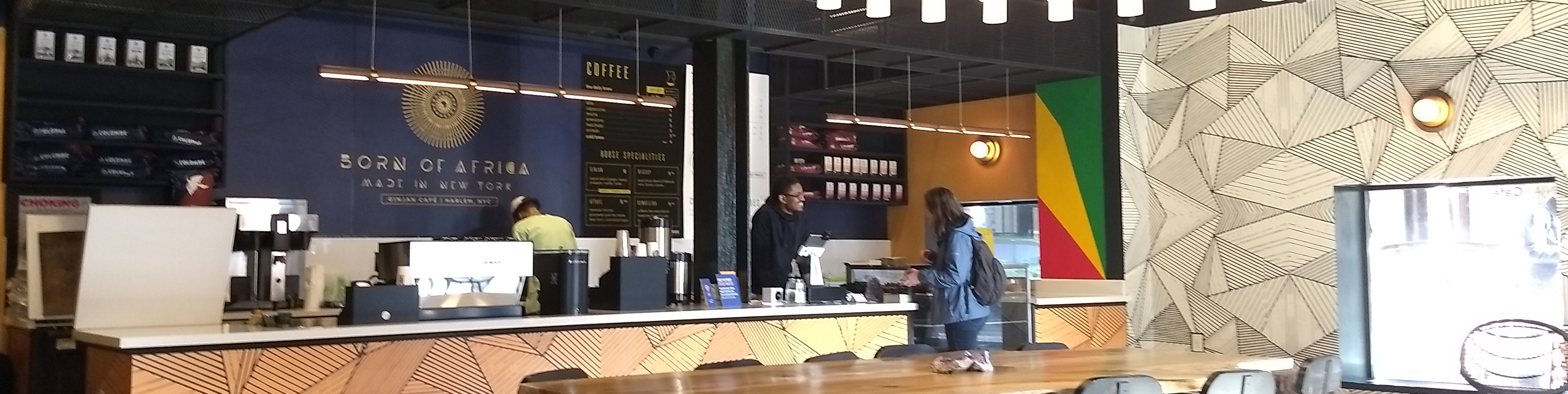
By now, the Diallo brothers have been quietly going at it for 4 years, starting at street markets and now servicing 40 Whole Foods stores in region, bottling the items about half a mile away at commercial kitchen operated by Hot Bread Kitchen bakery. “Born of Africa. Made in NYC,” marketing materials and café signage proclaim. Drink is packed in 10-oz straightwall plastic bottle whose label features bold African design motif. Lower part of label lists ingredients: ginger, pineapple, lemon, vanilla and anise. All are organic. Sweetener is cane sugar. It goes out at $4.99 a bottle at retail.
The expansive Ginjan Café opened in late Aug on street level of historic Corn Exchange Building on 125 St, across from major commuter rail station, with view to offering immersive experience, with menu of La Colombe coffee, homemade juices and other bevs and crepes, with wine/beer license on way. During recent visit we tried range of 3 juices. In-store version of flagship Ginjah drink gets self-foaming effect from use of pineapple, blended with ginger, lemon, vanilla and anise. Moroccan Mint tea uses organic mint, gunpowder green tea and caramelized sugar. And caffeine-free Kenkeliba employs the bush of that name from West Africa whose leaves contain higher antioxidant content than green tea along with bit of honey. (As digestive stimulant, kenkeliba often is used by Muslims in region to break fast during Ramadan.) Also in mix at café are items like ginger-based oatmilk latte. Info at DrinkGinjan.com.
As it motors toward more aggressive marketing activation in 2020 thanks to newly replenished funding war chest, Icelandic Glacial has signed on as official water of the Golden Globes Awards Ceremony airing on NBC on Jan 5. That represents a first for LA-based co, which will be distributed to nominees and guests on red carpet and at tables during show. Icelandic “looks forward to sharing the purest tasting water on Earth with Hollywood’s finest,” said cofounder/chmn Jon Olafsson. As part of collaboration, co will donate water to humanitarian cause selected by Hollywood Foreign Press Association.
SodaStream alternative called Sparkel that infuses real ingredients like cucumbers and mint into any liquid has set Nov 19 for ship date, at price of $100. Co offers streamlined alternative to PepsiCo-owned SodaStream, eschewing CO2 tanks in favor of compact “Carbonator” sachets. Also a feature is user’s ability to choose among 5 carbonation levels. Co is reserving further details until closer to ship date tho some info and images are available from IndieGoGo crowd-funding effort here.
CSD volume was virtually unchanged (-0.4%) last 4 wks thru Nov 2 in Nielsen all-channel data reported by Morgan Stanley’s Dara Mohsenian. CSD avg price increases were a full percentage point lower at +1.6% avg for 4 wks as each of top-3 suppliers had lower avg price gains. Coca-Cola CSD volume was up 2.7% (vs +3.1% for 12 wks) on small avg price hike of +0.6% for 4 wks. KO’s lower-cal sodas rose 2.9% on strength of Coke Zero while its full-cal brands were off 2.7%. PepsiCo CSD volume was down 4.7% even as its avg price increase was cut in half to +1.8% last 4 wks. PEP’s low-cal brands (-2%) outperformed full-cal offerings (-5.7%) for 4 wks. Keurig Dr Pepper CSD decline was down to just -0.2% (vs -1% for 12 wks) with avg price decrease of -3% (vs -4.1% for 12 wks) last 4 wks. Private-label brands suffered 1.3% volume dip on avg price gain of 0.9% for 4 wks.
Energy Takes Autumn Dip Energy drink volume gain slowed to +4% (down from +5.8% for 12 wks) with an avg price increase of 3.4% for 4 wks thru Nov 2. Monster Energy volume fell further, off 2.1% for 4 wks (vs -0.5% for 12 wks) while avg price increase was still up solid 4.6% in all-channel. MNST’s Bang fighter, Reign, reached ACV of 78.2% in last week, 90.3% in gas & c-stores, noted Dara. Red Bull volume gain decelerated as well to +5% (vs +6.4% for 12 wks) with flat pricing last 4 wks. Bang energy gained 122% (down from even more torrid +162.4% for 12 wks) on modest avg price increase of 1.3% for 4 wks. In all-channel, Bang market share of 7.9% in last week was down from 8% from prior 4 wks, while up a tick in gas & c-stores to 8.3%, added Dara. Rockstar volume down around 12% last 4 and 12 wks. Avg price increase down a few tenths to +1.2% for 4 wks. PEP energy brands slowed decline to -1.9% on avg price decrease of 0.5% for 4 wks.
Body Armor Still Driving Sports Gains Sports drink volume increased 6.7% on solid avg price increase of 4% for 4 wks thru Nov 2. PEP’s Gatorade volume was up 4.1% (slower than 4.9% gain for 12 wks) while avg price increase edged higher to +2.3% last 4 wks. KO’s Powerade volume was off slightly (-0.1%) even with steeper avg price decrease of 3.8% for 4 wks. Body Armor volume gain accelerated to +82% (up from +70% for 12 wks) on steeper avg price discount of -2.9% for 4 wks. Body Armor now at 10 share of segment $$ vs 17 share for Powerade, 71 share for Gatorade brands.
Nestle, PEP Drops Slow Momentum in Water Bottled water volume rose 4.2% last 4 wks, down from 5.6% increase prior 12 wks. Avg prices slipped 0.3%. Nestle decline more than doubled to -3% on small avg price increase of 0.7% for 4 wks. Coca-Cola water volume was off 0.5% (down from +0.7% for 12 wks) while avg price increase of 2.1% was unchanged last 4 wks. PepsiCo water volume declined 2.2% (vs -0.9% for 12 wks) with an avg price increase of 2.5% for 4 wks. Avg price gain +4% for 12 wks. Private-label brands were still up a solid 9% in all-channel with avg price decrease of 1.3%.
FLASH! Dairy Giant Dean Foods Files for Bankruptcy, Seeking Sale to Dairy Farmers of America
Dean Foods said it’s lined up its lenders on voluntary Chapter 11 bankruptcy filing as it tries to get to finish line on “advanced discussions” with Dairy Farmers of America to pick up “substantially all” of its assets. Troubled dairy giant based in Dallas filed petition in Southern District of Texas on behalf of “substantially all” of its assets, canceling planned Q3 earnings discussion that was set for this morning. Co has received commitment of about $850 mil in debtor-in-possession financing from lenders led by Rabobank so it can continue to operate as normal while sorting out exit options.
Amsterdam-based Natur Int’l, which recently acquired Temple turmeric bevs, seems to be toggling among even more strategies than Long Island Iced Tea, which segued to being Long Blockchain Corp and now has set deal with Stran Promotional Solutions that will require another corporate name change. Natur’s latest move: it’s set stock swap with Chinese co called Share Int’l that collaborates with gov’t there. Deal will yield new co called Share Natur International Corporation that will have ties not just to Chinese gov’t but also to major media co there called CQ News.
CBD player Good Day, which has adopted unusual occasion-driven strategy of offering entries in several bev categories, has fleshed out initial line with evening-oriented Chamomile Herbal Tea and afternoon-oriented Citrus Sparkling Water that augment initial morning-oriented Cold Brewed Coffee. All contain 15 mg of full-spectrum hemp extract and are packed in 8.4-oz slim cans going out at SRP of $6. Extract source is Vertosa (formerly Nanogen) of Oakland, Calif, which procures plants from Colo and runs them thru proprietary nano-emulsification process.
In discussion today, cofounder/ceo Warner Siebert allowed that complexity of strategy has proved more daunting than anticipated but said it’s being vindicated by brand’s ability to stand out amid sea of CBD twists on La Croix, at time retailers seem to be laying groundwork to establish comprehensive CBD displays and shelf sets once regulatory climate allows. At time he launched idea in SF (he’s NY-based now), Siebert was determined not to offer “another zero-calorie, naturally flavored crappy sparkling water” with CBD. The entries are all formulated from organic ingredients, aiming for certification once regs allow that for CBD items. In interest of great flavor, Good Day’s sparkling entry had to be taken up in development from 3 g of sugar to 6, mainly deriving from organic lime, mandarin and grapefruit juices. The tea offers lemongrass hit up front while joining hemp and chamomile bitterness at finish, he said.
Siebert is bringing fresh perspective to getting new bev out there after coming off last entrepreneurial success selling his BuzzTable guest mgmt system to Sysco, where he stayed on several years, culminating at Sysco Labs R&D arm. Working with cofounder Nick Miller, a former Facebook exec, he’s implemented a direct-to-retail sales model in which store owners can access a dedicated portal to order the products, in minimum orders of four 12-packs, delivered in next day or 2 out of pair of fulfillment centers. Next, they’re eying things like text-based inventory checks and SMS-based ordering. That setup brought inbound traffic from unexpected pockets of demand in heartland markets well beyond their Calif and NY mainstay markets, he indicated, to point that brand is available in 15 states over past 30 days. While chains remain on sidelines, retail base includes hemp/CBD shops and health & wellness venues like yoga studios, CrossFit boxes and meditation studios, as well as on-premise customers like hotels weaving product into non-alc cocktails targeting growing abstemious crowd. Now they’ve recruited outbound sales team to augment that effort and enlisted first DSD partner, NY’s Imperial India, which will focus on high-end retailers and foodservice opportunities like restaurants. (Imperial India also carries another local CBD brand, Brooklyn Hemp Co, profiled here just last week.)
As reported (BBI, Jul 23), Good Day operates out of offices in NY and LA and was financed by SF syndicate that included investors from founders’ prior ventures, some associated with bev brands like JuneShine (hard) Kombucha and Guayaki, and law firm Giannuzzi. Other cofounder, Andy Gabriel, is former Credit Suisse exec who picked up food/bev cred in subsequent gigs at Miami-based juice brand JugoFresh and HPP processor Nutrifresh Services. Warner said initial capital round amounted to less than $1 mil, with bridge round occurring to carry co to early 2020, when it plans to go after more significant raise.
BBI often likes to count protein shakes among once locked-down categories that now seem ripe for disruption, along with segments like sports drinks, energy drinks, coffee and sparkling essence water. On shake side, cold-channel leader Muscle Milk has struggled to innovate and grow even as wave of plant-based entries like Orgain and OWYN grab shelf space. Now there’s large-cap pure play for those who believe in segment: BellRing Brands, $854 mil (sales) marketer of Premier Protein brand that was just spun off from Post Holdings under BRBR trading symbol (BBI, Nov 16 2018 and Oct 7 2019). In inaugurating coverage, Credit Suisse’s Kaumil Gajrawala said he likes its prospects, pointing to Pure Protein’s compound growth rate of 18% over past 2 years (that brand reps 77% of BRBR’s total sales). Tho Premier boasts far fewer retail doors than players like Ensure, Boost and Muscle Milk, its velocity is just shy of $30K per point of distribution, per Nielsen grocery & convenience data, 2.5X that of Pepsi-aligned Muscle Milk and Coke-aligned Core Power, the next fastest-moving items. Note that Post still controls 71% of BRBR, which is scheduled for its first earnings release and conference call this Fri.
Why’s Gajrawala bullish? He cites Premier Protein’s positioning at intersection of 3 megatrends: functional bevs, protein and meal replacements. “Not for lack of trying, Coca-Cola and PepsiCo have yet to break through in the protein shakes category,” analyst writes in research note, with Core Power at just 2% share and Muscle Milk at 9% share (down nearly 2 pts in past 3 years). “We expect a less attractive margin profile relative to CSDs may be the holdback. Even niche beverage company Monster has failed to gain traction with Muscle Monster (1.7% share).” Meanwhile, private-label penetration is low and declining. Market leaders in category at nearly 14% apiece are Atkins, which has picked up 8 pts of share over past decade, and Ensure, which has stayed flat.
Still, at this stage of its development Kaumil would like to see Premier Protein diversify more beyond club stores that account for 60% of sales, noting that channel has been a boon so far but can be cruel to established brands that lose their novelty. Also in its portfolio are Dymatize whey protein powder and PowerBar nutrition bars, which have collectively been declining as they diversify out of waning nutrition channel in favor of broader food, drug and mass merch channels.
Sol-ti, the San Diego-based maker of glass-bottle functional bevs, has recruited new-age journeyman Rob Paladino as co’s prexy, augmenting exec suite that just added Ballast Point Brewing vet James Murray as coo. Rob is 14-year PepsiCo vet who since then has jumped into bewildering array of assignments in and out of bevs, on bev side including stints at Coors, InZone kids bevs, CoolJuice Beverage, WTRMLN WTR, Pure Brazilian Coconut Water and most recently nearly a year at Natur Int’l. Over weekend he confirmed move detected on his LinkedIn page but didn’t comment further; contacted via email, Sol-ti founder/ceo Ryne O’Donnell said co was readying a press release shortly. Sol-ti, which operates out of 15K-sq-ft plant in San Diego using UV process to avoid heating liquid, has counted among its funders the former Ballast Point principals Jack White, Murray and Jim Buechler, who briefly ran Sol-ti a coupla years ago when O’Donnell exited to pursue Costa Rican land development deal (BBI, Jan 24 2018). The former operations vp at Ballast Point, Murray’s mandate at Sol-ti is to help scale up production of what Ryne likes to describe as “living beverages.” Brand name derives from Latin for “of the sun” or “you are the sun,” reference to produce from which bevs are made.
FOR THE RECORD: Pure Brazilian Coconut Water Has Exited US We’d originally reached out to Rob this weekend to inquire about status of Pure Brazilian Coconut Water, whose foray into US he had directed. He confirmed that it’s withdrawn back to Brazilian base. We’d recently reported that another ambitious Brazilian entrant, Aurantiaca with its Obrigado brand, has similarly pulled back from US in tough segment with lotsa promotion and private-label activity (BBI, Sep 8). Aurantiaca is maintaining limited presence here while it more actively pursues adjacent markets like Canada and Caribbean where brand has performed better.