



Beer Marketer's Insights
"We are disappointed with today's verdict and are evaluating all options," Grupo Modelo spokesperson said after INSIGHTS broke news of verdict yesterday afternoon. "Did Modelo prove by a preponderance of the evidence that… Corona Hard Seltzer and Modelo Ranch Water are not 'beer' as defined in the contract," read question number one on Verdict Form. Clearly, the jury answered no, surprising many. But it's a huge win for Constellation on several fronts. Much more about big trial in tomorrow's Beer Marketer's INSIGHTS.
RTD Spirits Up 55% YTD Thru Mar 4; NÜTRL #5, Coming On; Truly #8; High Noon Share of RTDs
Here's peek at still hot (and still relatively small) RTD spirits segment in NielsenIQ data yr-to-date thru Mar 4, courtesy of Bump Williams Consulting. RTD spirits jumped $61.6 mil, 55% to $174.3 mil. That's a little more than 5% of total spirits sales of $3.3 bil and less than 3% of $7.3 bil in beer sales.
Members of family that founded commercial coffee equipment firm Wilbur Curtis Co are investing $22 mil in Indiana plant that will produce cold-brewed coffee and other bevs, Indiana Economic Development Corp announced. Operating as Common Collabs, the 3d- and 4th-generation family members of Wilbur Curtis will build 60K-sq-ft plant in town of Knox with anticipated hiring of 80 staffers in coming years, Inside Indiana Business reported. Given experience in sector, Common Collabs ceo Mark Parrish termed his co “a startup company with a head start” at ribbon cutting ceremony, per local coverage on WKVI.
Celsius Holdings rode its fitness-energy portfolio to 23% revenue gain to $20.4 mil in 3d qtr, as it stepped up marketing and built out DSD network to support presence that’s grown to over 60K retail doors, including Target, CVS and Kroger. Domestic revs soared 47% to $16.8 mil, while European revs sagged 11% to $3.37 mil mainly on timing issues and Asian revs plunged 86% to $195K as CELH undertook a reset there, switching to cash-conserving licensing structure in that market. Co scored $1.5 mil in operating income, reversing $4.09 mil operating loss a year earlier. SPINS syndicated data recently released by co indicates Celsius brand grew 41% in c-stores and 110% in groceries over 52 weeks ended Aug 8. Separately, co just added a new flavor to noncarb array with Grapefruit Melon Green Tea
For 9 mos, revs are up 35% to $51 mil, before inclusion of transformative acquisition of European distributor Func Food Group that will further boost topline, augment growth on Continent and yield a flock of ancillary products under Fast, Fitfarm and CocoVi brands. That deal closed on Oct. 25, after close of Q3. Operating loss for ytd narrowed to $127K from $10.23 mil a year earlier.
Smoother Sailing Anticipated for Func Food Func Food Group acquisition, which will be consolidated in Q4 results, will take CELH to $100 mil revenue run rate without diluting margins, while leading brand’s expansion into key European markets, Fieldly indicated. Recall that connection was made when Func acquired small distributor in Sweden created by pair of youthful Celsius enthusiasts. But co ran aground, stalling brand’s progress in Nordic region. So Celsius acquisition puts it on stable footing. “Past 24 months were overleveraged, but now they can focus on market opportunities,” Fieldly indicated, saying he has great confidence in Func team led by ex-Coke and Carlsberg exec Robin Lybeck. Celsius is seeking US copacker for Fast snack bars for launch online and via fitness channel next year, tho it will proceed gingerly and not take focus off core brand, Fieldly assured listeners today. While Func has been focused primarily on so-called hypermarkets to date, it’s edging into convenience, starting with 7-Eleven test in Norway. Another Celsius ally, Hong Kong-based AS Watson, also provides reach into Europe via its retail operations.
DSD Buildout Continues, with First Major Chains Cutting Over Recall that ceo Fieldly, tho he came from finance side of corp, quickly became outspoken advocate of DSD after getting top job (BBI, Mar 21). Having grown network from just 3 houses at start of year to about 70 currently, he rates co as about one-third of way to promised land of 250-300 needed to provide national coverage. As buildout continues, he’s anticipating that key regions in Target, CVS chains will cut over to DSD next year, with about 40% lift in sales/velocity anticipated from move. One key partner has been Big Geyser in NY, which has already been servicing local 7-Eleven stores and is getting local Target stores later this month. Brand has full coverage in Ariz, so that’s next likely market, as are Michigan and perhaps Southeast region. Fieldly is figuring it will be another 12 months until full network is established.
Keeping Cool on Celsius Heat for Now Tho Celsius Heat line developed as endemic line for fitness channel offers close matchup to fitness-energy leader Bang Energy, Fieldly said co will continue to tread cautiously in 16-oz segment where giants have been slugging it out. Asked about prospects for brand, with 300 mg of caffeine and other attributes like Bang, ceo pointed to Monster Beverage’s launch of Reign via buy-one, get-one deal and Bang’s heavy discounting in period, too. Heat is drawing significant retailer interest and “is going to be a major contributor in our portfolio going forward,” but CELH will take it a step at a time.
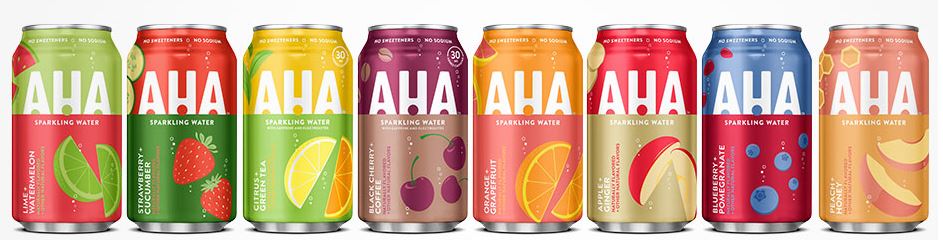
Over past few years Coca-Cola has been missing out on big growth opportunity in bevs: sparkling essence category ignited by La Croix that’s spawned wave of wannabes including Bubly from archrival PepsiCo. After trying to maneuver existing brands like Dasani and acquired Topo Chico into space with middling results, KO is acquiescing to market reality with planned rollout of brand named AHA in Mar – its “first major brand launch since 2006,” when Gold Peak debuted, as co noted. “As the largest and fastest-growing part of the water business, mainstream flavored sparkling water is a segment we know we must double-down on,” said Celina Li, vp for water at Coca-Cola North America. “AHA is our big-bet brand in this big-bet category.”
AHA will be packaged in 8-pks of colorful 12-oz and 16-oz cans. It will be avail in 8 “unsweetened, zero-calorie offerings” with “unexpected yet accessible flavor pairings,” per co. Those flavors include: Strawberry Cucumber, Lime Watermelon, Peach Honey, Blueberry Pomegranate, Orange Grapefruit, and Apple Ginger. AHA’s 2 other offerings, Citrus Green Tea and Black Cherry Coffee, will carry mild lift of 30 mg of caffeine, riding emerging sub-segment whose indie entrants include likes of canned Limitless line and unsweetened sparkling teas like Sound. By contrast, Bubly sticks with down-the-middle flavors like Lime, Raspberry and Cranberry, while La Croix reserves more complex flavor combos for its slightly more premium CuraTe extension. To make shelf space for AHA, Coke will bounce 5-year-old Dasani Sparkling line from retail shelves but keep it available as an option on Dasani PureFill and Coca-Cola Freestyle machines. CCNA said it brought AHA from concept to prototype “in just over 6 months,” including extensive research with “thousands of consumers – from sparkling water loyalists, to occasional drinkers, to those who’ve tried a brand or two but haven’t found what they like.” As noted often in this letter, lotsa brands are making bets that palate fatigue might be creeping in among La Croix users, offering chance for more premium entries with more complex flavor profiles, hint of sweetness or caffeine or both, or richer base, like tea. “Our partners told us, ‘We don’t need yet another lime- or berry-flavored sparkling water. We need something fresh and new that can help grow the category’,” said sparkling water dir Julie Siwemuke. (Recall, tho, that unaligned essence water player Hint abandoned similar strategy after concluding that the volume lies in core flavors.)
Coupla other intriguing angles to this. For one, it shows how co prefers to deploy its own trademarks in growth segments, as it’s doing with Coke Energy and as it tried to do with alkaline extension of powerful Smartwater brand. Latter effort doesn’t seem to have panned out, to point that rumor mill now has KO among broad array of strategics that are kicking tires of segment leader Essentia. Launch also reflects ceo James Quincey’s push for greater urgency and alacrity in product development, with AHA team moving quickly from 800 potential flavors to 50 and then final 8. We got another glimpse of that recently at NACS c-store show, where KO intro’d Gomega “omega-3 superfusion” functional brand that had spent only 20 weeks in incubation (BBI, Oct 2). So, tho results remain to be seen, things are movin’ a lot faster at Coke these days.
Keurig Dr Pepper produced another solid quarter in Q3, claiming continued share gains in core categories like CSDs, premium water and shelf-stable juice. But it acknowledged it’s got some work to do on Bai and Snapple’s teas even as newer allied-brand partners Evian, Peet’s and Forto are taking longer than anticipated to ignite. “We have a good line of sight to improve the performance across all 3 of these areas,” prexy/ceo Bob Gamgort assured investors on conference call this morning. Tho allied brands created a 5.8% sales headwind in Q3, that switches to tailwind in Q4 and growth driver in 2020, he asserted. He promised more specifics on fix-it efforts early in new year for portfolio that currently generates about $350 mil in annual sales at retail. Of course, allied brands normally comprise the fastest-growing part of overall portfolio in generally premium newer categories.
For Q3, KDP’s net sales grew 5.1% to $2.87 bil thanks to impact of Dr Pepper Snapple Group acquisition. Excluding that, sales edged up just 0.5%, with underlying sales $$ growth of 3.1% offset by erosion among allied brands, -2.7%. Some of that is mere bookkeeping issue, given that acquisitions of Big Red and Core Nutrition shuttled those portfolios from allied brands to packaged-bevs side of ledger. Indeed, Big Red and Core, combined, do more in sales than remaining allied brands, Gamgort noted. Also a factor was exit of pair of strong growth brands, Fiji Water and Body Armor. And as Gamgort readily allowed, new batch of allied brands, including Fiji replacement Evian as well as Peet’s and Forto entries from affiliated JAB unit Peet’s Coffee, proved slower out the gate than he’d hoped. Another allied brand, Bang Energy challenger Adrenaline Shoc Smart Energy, devised by Core creator Lance Collins, is off to good start. Other brands in allied portfolio, including Vita Coco, High Brew and Neuro, were not mentioned on call. Thanks in part to merger synergies, KDP’s adjusted operating income in Q3 rose 8% to $754 mil.
“As we look at new brands, we think it’s primarily just a delay,” Gamgort assessed to one questioner on call. Those entries are getting distribution and their velocity is building, “just not at the rate we thought it would be.” Evian, for instance, grew by 8% at retail over past 13 wks, trailing category’s 12-13% but still “not too bad.” The temporary adversity “doesn’t really affect the way we think about allied brands going forward” in terms of stepping up acquisitions or other activities, he indicated. New partnerships like A-Shoc will continue to fill pipeline, always with pathway to KDP’s full ownership negotiated up front. That’s intended, of course, to avoid situations, as under predecessor mgmt team, where brand like Bai can shake down co that incubated it for whopping $1.7 bil payout.
More broadly, all 4 KDP segments – packaged bevs, concentrates, Latin America and Keurig coffee biz – demo’d underlying net sales growth and topline was balanced between volume/mix gains and price realization, driving 13% eps gain. So, “with 5 quarters behind us as an integrated company, we have demonstrated that our value-creation model is working,” Gamgort declared.
Packaged Bevs Hit by Allied Brand Hiccups; ‘Renovation & Innovation’ Should Cure Bai’s Woes Packaged bevs segment suffered 2.2% sales decline to $1.34 bil on pro forma basis, because of that 5.8% headwind from allied brands. Thanks to strong merger synergies, adjust operating income climbed 23% to $201 mil. Among individual brands/segments, Dr Pepper and Canada Dry franchises helped KDP win share in CSDs, while Core Nutrition was strong performer in premium water, up over 30% in scanner data over past 52 weeks. Snapple juices and Mott’s were credited with gains on juice side, and Sunkist and A&W also were growth contributors. But that expensive Bai acquisition suffered another quarter of decline as marketing programs failed to provide anticipated lift. By now, of course, Bai’s founding team is long gone and some trade partners sense general lack of inspiration behind once-torrid brand.
Asked what’s source of Bai’s woes, Gamgort deemed it “pretty straightforward” issue of pioneer brand generating new competition and needing to be refreshed. It’s still doing half a bil in sales at retail, up 3% over past 52 weeks, so it’s by no means falling off a ledge, he maintained. Combo of “renovation and some innovation” to be shared early in 2020 should right the ship, he believes.
Keurig Coffee Ekes Out 1% Sales Gain; Duo System Off to Good Start On Keurig side of biz, net sales rose 1.1% to $1.07 bil, tho avg prices edged down another 1.9%. On pod side of biz, Gamgort again reminded analysts that the syndicated data they track reps barely half K-Cup segment, excluding fast-rising ecommerce channel as well as healthy Canadian market. So pod shipments rose by 6.1%, not the 2% reflected in IRI data, he emphasized. Co’s enhanced array of brewing systems, including Duo system that makes both single cups and full pots, enjoyed 8% growth. Gamgort cautioned, tho, that innovations like Duo typically are slow build, because households tend not to upgrade brewers until their current unit breaks. In part because of ongoing pricing issue as well as tilt in mix toward branded partners offering lower margin, adjusted operating income for segment declined 3.4% to $367 mil. Among key initiatives, Gamgort promised that recyclable pod will be implemented by end of 2020, serving as counter to sustainability issue dogging category.
PepsiCo, which contributes massive amount of plastic waste to the environment, has positioned its DTC Drinkfinity brand as a sustainability play, allowing users to harness juice-based pods to produce range of bevs consumed in reusable bottle. But sustainability has been a moving target and Drinkfinity’s plastic bottle has been increasingly out of synch with consumer vibe as anti-plastic backlash builds. So Drinkfinity has done a pivot, launching stainless steel, vacuum-insulated bottle with spherical top into which to insert pod.
Plant-based alt-dairy player Mooala has pulled in $8.3 mil Series A raise led by fellow Texas co Sweat Equities, bringing total funding since launch to over $13 mil, co announced yesterday. Participating in round was M3 Ventures, which had led seed round. Sweat Equities, with Charlie Sweat as managing ptnr, said Mooala anticipates doubling sales this year, having expanded its bananamilk to 2,500 retail doors, including likes of Whole Foods, Safeway, Kroger, Wegmans and Costco. Another 1K doors should be in mix by Jan . . . Green Rabbit, a Braintree, Mass-based co that aims to automated distribution, fulfillment and delivery of perishable foods & bevs, has pulled in $31 mil minority investment from Boston-based Guidepost Growth Equity, RefrigeratedFrozenFood site reported. New investment will allow Green Rabbit “to accelerate growth and scale the development of our proprietary platform to ensure that the fulfillment processes protect perishables and help our customers grow their ecommerce foodservice initiatives,” said Green Rabbit cofounder/ceo Greg Balestrieri. Guidepost partner Doug Kingsley and principal Won Park are taking seats on Green Rabbit’s board. Green Rabbit currently distributes and fulfills over 5K items from 150+ brands, offering retailers and CPG cos nationwide 1- and 2-day coverage . . . WeWork may be in crisis mode, needing bailout from key investor SoftBank and scrapping plans for schools and living spaces, but it’s continuing to build out WeWork Food Labs concept, at least for now. It just added SF unit based in 70K-sq-ft North Beach building as complement to original unit established in NY, looking to provide a home to startups at intersection of food and tech who’re looking for environment conducive to landing mentors and investors. Office can house up to 100 people working for startups in food tech, agriculture, consumer product design and other food-related areas, SF Chronicle reported, with initial clients including seaweed snack co 12 Tides, food/bev importer Brands of Britain and ESV, a mobile app that shares health and safety info about food products. Operation doesn’t include a commercial kitchen, but has partnership with KitchenTown in nearby San Mateo.
PEOPLE: CMO Olivieri Steps Up to Prexy at OWYN Plant-Based Bevs; New Age Bev Names Garlikov as CMO
OWYN, the fast-growing plant-based nutrition bev brand controlled by Halen Brands, has elevated cmo Mark Olivieri to prexy, with Halen co-owner Jason Cohen stepping back to broader oversight role. The move at brand created by married pair of ex-athletes (its name stands for Only What You Need) culminates extensive search, Jason told us, in which co concluded internal candidate, Olivieri, was the best qualified. “Not only is he the first employee of OWYN, working on the brand 8 months before launch similar to any founder, but he has been pivotal to most strategic decisions behind the brand,” Jason told us in email yesterday evening. “His dedication and passion for the brand and extensive knowledge of the category makes him a strong and successful leader.” After stints at Pepperidge Farm, Hain Celestial and PepsiCo’s Frito-Lay unit, Mark first teamed up with Cohen as marketing dir for sports nutrition at Nature’s Bounty, then segued to OWYN in early 2017 as svp marketing, before getting bump up to cmo and gm for ecommerce. He declared to us that “OWYN is winning the nutrition war by delivering a message of truth and transparency validated by our free-from positioning,” a reference to qualities like allergen-free recipe. “We have won this battle against legacy competitors in all classes of trade. The next stop for the brand will be continuing to build out our lifestyle platform while further establishing our dominance as the highest velocity protein brand” . . . New Age Beverages this week brought aboard former Shaklee exec Julie Garlikov as cmo. Julie joins after filling similar role at nutrition marketer Shaklee after earlier serving as vp & global marketing chief at skincare firm Rodan & Fields. Earlier in her career she did stints at big CPG players like PepsiCo, Johnson & Johnson and P&G.
Brooklyn Hemp Co, vertically integrated cannabiz launched by former corporate attorney in tech sector, is pivoting from tinctures to bevs as co’s workhorse as it readies expansion, seeks copacker and plans early-2020 capital raise behind line that soon will bring uncommonly high payload of 50 mg of organic full-spectrum hemp extract, amid sea of CBD bevs focused more on 10-20 mg levels.
Co launched by Heather John boasts unusual credential of having become first authorized CBD producer to commence operations in NY State and first given OK to produce edibles, out of 1,800-sq-ft site at eastern fringes of Bushwick nabe. It's still only licensed producer in city limits. Brooklyn Hemp procures its hemp from upstate grower, grinds it and extracts it via proprietary method, then renders the pure hemp oil extract water-soluble. It’s incorporated into syrups, all on-site, as is subsequent bottling, at least for now. “Absurdly vertically integrated,” John jokes, tho she believes that could prove competitive advantage as consumers learn to scrutinize provenance of their CBD edibles. Tho co got in game with extensive suite of full-spectrum tinctures and capsules, those are being eased out now in favor of whole-hearted push behind bev line, restaged to suit changing regs from botanical “sodas” to “tonics” now identified not as food product but as dietary supplement. Those are out now in 16-oz glass bottles containing 45 mg of full-spectrum hemp, including meaningful amount of THC within legal guidelines, figure that will soon be upped to 50 mg. It’s out in Strawberry Rhubarb and Lemongrass flavors, priced around $9, with 2 more flavors in the queue for next month. Front label emphasizes that product contains 200+ terpenes, cannabinoids and phytonutrients contained in hemp plant, for full entourage effect. Co soon will venture into another edibles area, vegan gummies, Heather told us in conversation yesterday.
So far brand is in just 100 or so retailers in NY via pair of small distributors, but it’s in discussions to expand throughout Northeast and Mid-Atlantic in coming months and is eyeing South Florida as potential 2d market. Heather commenced $2 mil seed round this past summer, but put it on hold until early next year in favor of smaller raise as she struggled to meet demand. Label will get reskinned for more chic look, she’ll migrate to glass pack that does better than clear bottle at shielding liquid from UV rays, take out a bit of sugar and, as noted, up the hemp content to 50 mg. She’s still considering whether to identify product on front label as hemp or CBD. Tho tinctures are still for sale in local stores and on website, that’s only until inventories deplete, John said. “Anyone and their dog can make a tincture at this point,” she said. It’s become cluttered segment that she doesn’t regard as particularly interesting.
Venture is outgrowth of hemp-extraction idea that John’s former boyfriend enlisted her to participate in. She relocated from San Diego to give it a go but it didn’t pan out. Tho she’d been recruited to handle legal side and didn’t view herself as operations type, she was hooked on potential opportunity in segment growing 700%. So with license in hand, she bought him out a year ago and continued on her own, building out the Brooklyn facility and getting some guidance on navigating bev sector from a local friend, Pilot Kombucha founder Alex Ingalls (tho she’s aiming to assemble a formal advisory board now). By Jan or so, as bigger round comes in, she’ll be ready to recruit vp sales and marketing people. She notes that her current investors, tho not bev vets, are seasoned entrepreneurs who’ve offered good reality check as she’s navigated unsettled sector.