



Beer Marketer's Insights
STRATEGY: Briskly Growing Good2Grow Broadens Retail Reach, Adds Podz-Topped Water for Older Kids
Good2Grow, which has parlayed the character tops perched on its juice line into several years of consistent double-digit growth, is broadening its retail footprint to include less-obvious accounts like adult clothing chains – anywhere restless kids must wait while their parents are busy being really boring – while adding a water line called Podz that targets older kids age 7 to 12 and fomenting kids’ acquisitive urges via site called Collector’s Club. By now indie brand is claiming 22 straight months of growth in declining juice category; it’s believed to be doing over $40 mil in annual sales, in kids’ sector where endless promos on brands like Capri Sun have made for punishing experience for unaligned brands seeking a piece of the action. Working mix of direct shipments and DSD to get into cold boxes, Good2Grow claims to be #1 immediately consumed kids’ juice, as opposed to all the brands that go into fridge at home or kids’ lunchboxes.
Good2Grow, recall, was new brand name created by Atlanta-based co to supersede monikers like Bellywashers and TummyTicklers that were alienating parents who were getting more concerned about their kids’ sugar intake. The co, founded in 1997, had been taking sugar out of the drinks, but the branding didn’t reflect that. The rebrand in 2013, orchestrated by former Coca-Cola and FRS exec Carl Sweat, who’s since moved on, succeeded in placating the gatekeeper moms, but it turned out there was more work to be done, as brand marketing vp Edzra Gibson said he discovered upon joining co 2 years later. It still needed to do more to win over the other key consumer, the kids themselves. So co amped up the character side of the biz, via addition of properties like Trolls, with the diversification serving to augment “treasure hunt” aspect of shopping for Good2Grow. Co had already numbered range of Disney, Nickelodeon, Hasbro and Warner Bros characters in portfolio. By early next year, the co should be approaching 300 characters, including good mix of gender-neutral ones like Paw Patrol and Mickey Mouse, Edzra said. They go out to retailers in randomized assortments. Along the way, Gibson and his colleagues upgraded the labels to better ID the nutritional benefits of each product, which includes 100%-juice entries, organic line that cuts sugar by 75% and Fruit & Veggie blend. The co produces the bevs itself near Atlanta, assembling the character packs from imported Asian components.
Recently added Collector’s Club aims to heighten urge to buy the drinks by allowing kids and their parents to track their collection, with reward of exclusive content and entertainment. Membership has already moved beyond 65K. (Tho co has DTC biz, kids and their parents can’t short-circuit hunt by ordering missing tops online, which is confined to bulk selections of most popular items, for parties and the like.)
Now, with the biz humming, Good2Grow is making more concerted effort to retain those consumers as they age out of core demo, via launch of Fortified Water Featuring Podz, offering larger pack size of 10-oz and eschewing sippy-type tops for twistoff domed lid featuring characters from properties like DC Comix, Marvel Comics, Trolls, Shopkins and My Little Pony. The line, out in Orange Mango and Raspberry Lemonade flavors, is fortified with vitamin D and calcium and contains just 3 g of sugar, none of it listed as added sugar, for 20 calories per bottle.
Broadening Retail Reach By now, brand is represented in every retail channel except club, which is being addressed now, Edzra said. Convenience channel is as strong as ever, and brand is making inroads into larger-format stores, holding its own in Walmart and Target and demonstrating growth in range of high 20s and low 30s in Kroger and HEB. After earlier parting of ways, brand is back in Meijer chain. Drug channel had been a challenge on account of what Gibson called “mismatched goals” but has since been righted. Now brand is working to enter unconventional new channels – anywhere, essentially, where kids are likely to feel they’re entitled to a reward for cooling their heels while their parents engaged in boring pursuits like clothes shopping. Strategy makes sense for brand that’s viewed internally not so much as a bev but as an experience, justifying premium price and presence in unconventional retailers like clothing chains – anywhere restless kids are parked while their parents go about their business. So brand has been finding it can perform well in chains like Roth’s and Burlington Coat Factory. “We can sell anywhere that kids have got to wait” as a reward for good behavior, Gibson theorizes. Parents view it as a toy and appreciate the reusable bottle, feature that’s helped shield brand from plastic-bottle backlash. Tho it picks its spots, Good2Grow relies on DSD in some markets, finding that front-of-store displays bring great incrementality, not just to Good2Grow but for juice category as a whole.
Tribucha Kombucha, based in Cary, NC, is embarking on $2 mil capital raise as it seeks to graduate to its own brewery while steadily building out retail base that stands at about 1,100 accounts, mainly on East Coast. At last month’s Natural Products Expo East, Tribucha added Lemon Ginger and Goji Berry flavors to existing lineup whose most striking item is Controlled Burn, harnessing ginger, cayenne and turmeric for massive bite. With other flavors like Flowers of Life, Main Squeeze and Brainiac, the line is packed in colorful, brilliantly detailed 12-oz cans. Another flavor, Café con Bucha, which melds coffee, cinnamon and cacao, will dial up coffee punch, per ceo Paul Pritchard.
So far, Paul told us at booth, brand has focused mainly on East Coast, but its base of retail chains by now has grown to encompass Central Market in Texas, Whole Foods/Southeast, Ingalls, Earth Fare and The Fresh Market. Tribucha currently rents space at Fortnight Brewing in Cary, using brewer’s canning line 2 days a week, but is about to embark on raise of over $2 mil to support buildout of its own brewery, as well as staffing push to accelerate expansion. An earlier raise of under $500K in late 2016 had supported acquisition of fermentation tanks and other gear to be installed at Fortnight (BBI, Nov 4 2016). “Drink consciously,” is brand’s slogan at Tribucha.com.
Sparkling tea marketer Zest Tea has headed into zero-sugar realm with Blackberry Lime flavor that’s first in what are to be series of entries sweetened with combo of stevia and erythritol. Like core line, keto-friendly new sku is packed in 12-oz slim can styled at top as an “energy tea,” with hefty dose of 120 mg of caffeine supplemented by 100 mg of L-theanine for slow release. They’re all priced at $2.49-2.99. Core line of Passionfruit Berry, Spiced Chai Infusion and Pomegranate Mint carries 150 mg of caffeine, about 3X a cup of tea, as website advises.
Baltimore-based co launched by ceo James Fayal has been taking deliberate path to growth, going national with its bagged teas but focusing mainly on Eastern Seaboard with the RTDs. The biodegradable bagged teas, which just dropped tins in favor of chipboard box, by now have entered about 2,500 accounts nationally via broadliners UNFI, KeHe and DPI, James told us earlier today. The change in outer pack has enabled a drop in price to $5.99-6.99 range per 15-sachet box. The RTDs so far are employing a single DSD partner, Dora’s Naturals in NY, but otherwise using broadliners to service accounts like 7-Eleven and Whole Foods in the Mid-Atlantic region, along with Shaw’s in Northeast and Harris Teeter in Southeast. They are augmented with merchandising support from likes of Dirty Hands org, supporting Whole Foods accounts.
So far, effort has been funded by angels and family offices, but company is raising modest round a bit over $1 mil en route to larger round next year, coo Elias Meyer-Grimberg told us at recent Expo East in Baltimore. Speaking this morning, Fayal said current round should be completed in coming months.
Looking toward 2020, Whole Foods is touting possibilities of zero-proof drinks in its annual trends outlook. “Many of these beverages seek to re-create classic cocktail flavors using distilling methods typically reserved for alcohol, creating an alternative to liquor meant to be used with a mixer rather than a drink on its own,” natural foods retailer opines to its customer base. “Think alt-gin for gin & tonics and botanical-infused faux spirits for a faux martini. Add to that options enjoyed straight from the bottle or can, like hops-infused sparkling waters and zero-proof apertifs, and you can be sure guests avoiding the bar cart will never get bored.” As examples that are currently or soon available in Whole Foods are HopTea sparkling teas, non-alc beers like Athletic and Heineken 0.0 and Kater Wingman sparkling waters, packed in longneck glass bottles and given dose of electrolytes. Other trends heralded in outlook are regenerative agriculture, new wave of flours, fresh snacks, foods from West Africa, plant-based foods beyond soy, butters & spreads, new array of kids’ meal options, meat-plant blends and “not-so-simple sugars.” Predictions can be viewed here.
AriZona, seeking another lower-sugar growth platform, is readying a seltzer-like entry called Santa Fe Sparkling Water that harnesses “a splash of real fruit” to offer a soda alternative that’s a bit more robust on the palate than La Croix or Spindrift. New entry, in vibrantly colored 16-oz cans usually dominated by image of a fruit slice, has been crafted in Lemon, Orange Mango, Raspberry Lime, Pink Grapefruit and Arnold Palmer flavors, and seems to be only lightly branded, if at all, as an AriZona item, possibly in recognition that trademark has become too tightly tied to highly sweetened bevs that define brand. (Of course, Santa Fe’s own Southwestern-themed branding is entirely consistent with core brand.) Santa Fe contains just 2 g of sugar (15 calories), can copy seems to indicate. No immediate response to inquiry on pricing and rollout plans, including whether launch will start with core AriZona-controlled distributors in NY, Chicago and Florida, as is often the case, or go beyond that.
By now, imagery of new line has been trickling out to social media, including Instagram feed of Moon Mehta (@moonmehta), whose Mpire Creative has worked on numerous AriZona projects over the years, including cobranded sodas with Shaquille O’Neal, Skinnygirl slenderizers and Joe DiMaggio-themed RTD coffee called Joltin’ Joe.
Group of 6 entrepreneurs in Southern Calif, all of them with Facebook stints in their backgrounds, have teamed to create a brand called Monday Zero Alcohol Gin targeting the growing ranks of youthful consumers who don’t drink. Their announcement says brand will be crafted and bottled at co’s distillery in LA using botanicals that are familiar to genre such as juniper, coriander seed and citrus, aiming for London dry gin flavor with characteristic bite. First bottling is anticipated for mid-Nov.
Is private-equity shop First Beverage Group edging toward an entry into the cannabis biz? LA-based co founded by longtime beer distribution exec Bill Anderson appears to be offering assistance on commercialization to Mad Tasty CBD Infused Sparkling Water, brand devised by pop band OneRepublic’s frontman, Ryan Tedder, with potential for equity investment to follow. Our contacts tell us FBG managing partner Jack Belsito has been on the road with Mad Tasty principals opening the door to potential retail and distribution partners, tho as far as we can tell no investment has been made yet and Mad Tasty isn’t listed in portfolio section of FBG website.
Mad Tasty is Santa Monica, Calif-based brand that employs emulsifying process developed by Seattle-based Sorse Technology to provide 20 mg of hemp-derived extract that’s evenly dispersed thru liquid, with no added sugars or sweeteners, in Watermelon Kiwi and Grapefruit flavors. Catchy can graphics employ line art a bit reminiscent of Keith Haring. We couldn’t get comment when we reached out to Belsito today, but First Beverage is listed as “collaborator” on Mad Tasty website at MadTasty.com, along with Sorse and Interscope Records, OneRepublic’s label. Among other cannabis brands “powered” by Sorse are Happy Apple, Utopia, Pearl Mixer, Vertus and THC-infused Reeb Bitter Barley Soda. Tedder, of course, by now has built diverse entertainment career, including as producer of NBC musical competition series Songland. Wrung out from life on the road, he gravitated to opportunity of CBD, as he told one interviewer, and seems to be generating some early buzz behind brand.
Fueled by recent $3 mil capital raise, Weller CBD bevs has been in expansion mode over past 3 months, broadening retail and distribution range while taking steps to lock in robust supply chain in segment where that’s likely to become more of a differentiator.
Weller, recall, was founded by Third Street Chai founder John Simmons and Frontier Bites founder Matt Oscamou, who started with 5-packs of coconut bites each containing 5 mg of CBD and then added canned sparkler that brings 25 mg of CBD. They’ve since dialed that down to 20 mg, but are selling at aggressive price point of $4.99 vs rival entries that may cost $1 more for half the dosage. Because of vagaries of regs around US, Weller’s 12-oz cans go out labeled as CBD or hemp-based, depending on locale, a departure from earlier insistence on sticking with CBD as sole identifier.
In discussion on Fri, Simmons told us that Weller had quietly brought in $3 mil round of equity capital 3 months ago from consumer-focused Brand Foundry Ventures and from LivWell, investment vehicle operated by Nutrabolt founder Doss Cunningham and his longtime friend and partner Bryan Bulte. Also participating was Great Oaks, which John said has affiliation to Polar Beverages owners. Earlier $1.25 mil equity round had included early-stage VC Harrison Metal, vehicle of former eBay exec Michael Dearing, as Simmons had disclosed in BevNet Live presentation this past spring (BBI, Jun 20).
That new funding is serving as launchpad for what Simmons described as “pretty massive scale-up” that’s seen brand recruit Denver-based Vistar, initially to work 14 CBD-friendlier states in Pac NW, Mid-Atlantic, Florida, Texas and Calif, and flesh out DSD and retailer footprint in key markets. Tho mainstream chains have remained wary of segment, Weller has added such chains as New Seasons in Pac NW and Lassen’s in Northern Calif.
Fresh Thyme and The Fresh Market are aboard, as are 31 Sprout’s Farmers Market stores in Colo, serviced by network of 6 different distributors including CBD specialist MarketHub that’s a partner of Presence Marketing. Better Health chain in Mich also is running with brand. On foodservice side, Weller numbers as customers Thomas Hammer Coffee Roasters chain in NW, as well as Ink Coffee chain in Colo, both with over a dozen locations. Simmons’ key colleague on buildout is sales vp Megan Jansen, who worked for him at Third Street Chai and later moved on to Bhakti Chai.
In LA, Weller employs LA Distributing as DSD partner, augmented with Critical Mass Group, as partners navigate local health dept’s stepped-up enforcement since Oct. (John said he’s teamed with local rival Vybes on advocacy org seeking regulatory clarity in segment.) In NY, Weller is working with local DSD house Rainforest, supported by Boost Sales & Merchandising, with 100+ accts enlisted to date. Among chains in area, Wegmans has taken CBD products off its shelves, but Fairway has retained them as long as they say hemp, not CBD. In NY as well, local health dept cracked down on CBD items starting in Oct, tho those labeled as hemp seem to stay out of crosshairs.
At BevNet conference in Jun, Simmons had offered frank assessment of myriad operational challenges confronting those playing in CBD at this early stage, citing procurement as key issue. That’s a focus at Weller, which anticipates identifying by year-end a strategic supply partner with whom co will work on self-affirmed GRAS certification for core ingredient, at time some rivals are sourcing from suspect suppliers. Recall that, asked at BevNet what keeps him up at night, Simmons had replied, “bathtub CBD, online CBD unregulated.”
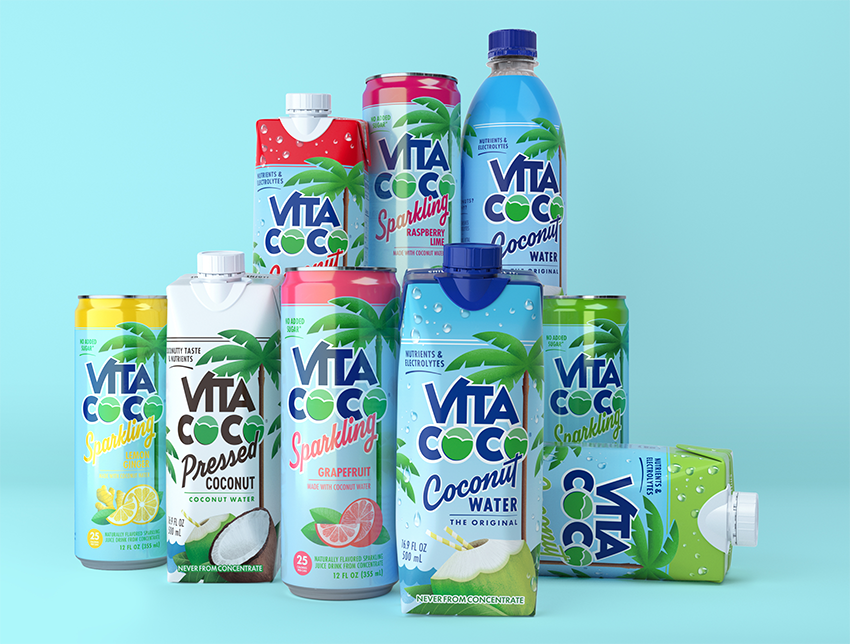
As it expands into new segments and formats, Vita Coco has undertaken its first significant brand refresh in its 15-year history, enlisting agency Interesting Development to streamline look without undermining its quirky, craftsy vibe. New look stylizes logo, moving away from naturalistic coconut images that represented the “O” in “Coco” and dropping the palm fronds springing out of top of logo, but by no means dispenses with joyous tropical vibe or slight air of imperfection, said brand dir Allison Finazzo, who said she worked closely with founder/ceo Mike Kirban on project. (Allison is in marketing dept run by Jane Prior as cmo, at parent co called All Market Inc.)
Allison said effort intends to elevate and differentiate brand on shelf, at time it’s grown beyond narrow range of uncut and flavored coconut waters to encompass coconut milk, canned sparklers and major extension, Pressed, that incorporates coconut puree to offer more of the flavor some consumers expect from their experience with coconut-flavored ice cream or sparkling water. This is happening in environment in which there are lots more coconut water brands on store shelves than when Vita Coco launched, many of them similar in look.
Among major components of what she prefers to call a brand “refresh” rather than makeover is to convey the craft involved in bringing the juice of Asian coconuts to your fridge, with on-pack copy doing more to communicate such storytelling elements as brand’s ties to local farms and communities, and why and when consumers should use the product. Another priority was to simplify the illustration style, tho without losing all the quirkiness, so broader range of products and formats maintains consistent look. And the typeface was made more consistent.
One area where changes will stand out more is in treatment of Pressed extension, whose Tetra Pak gets white background so item jumps out as more than just a flavor extension, given role in recruiting skeptics to brand that was flagged in “Impossible to Hate” campaign. Half-open coconut seen in foreground of brand’s front panel includes ample bit of coconut meat to flag distinction. As reported, Press launch represented a bit of an “aha” moment when co realized it needed to do more to reach sizable portion of consumers who’re repelled by taste of coconut water – much, as Finazzo pointed out, as coffee marketers are able to win over coffee skeptics with items like Frappuccino. Vita Coco execs say Pressed launch has reinvigorated their biz.
Danone’s venture arm has taken minority stake in SF-based Forager Project, which has built out broad array of plant-based food and bev products in synch with major strategic priority of French dairy giant. Founded 6 years ago by Odwalla vet Stephen Williamson, Forager offers array of plant-based yogurts, sour creams, half & half and bottled protein and probiotic shakes. In announcement, Stephen described 3-year wooing process that convinced him that ceo Laurent Marcel and rest of Danone Manifesto Ventures team are “good people with leverageable, relevant experience and capital.” It joins US investments by DMV comprised of Harmless Harvest coconut water, Farmer’s Fridge and Sustainable Bioproducts.