



Beer Marketer's Insights
Keurig Dr Pepper said it’s developing “state-of-the-art production and warehouse facility” in Allentown, Penn, at cost of about $200 mil. Brief announcement today touted “highly efficient capacity for existing and new brands” but was devoid of any specifics on what processes and pkg formats would be supported there beyond quote from chief supply chain officer Fernando Cortes that it would do “all beverages in all categories.” That’s a lot of kinds of beverages! Local media describe site as 92-acre former KraftHeinz location vacated in late 2016 that will offer 811K-sq-ft of mfg/warehouse space to soda giant.
CANNABIZ: ‘Do Not Go Gentle . . .’ Is RavenQuest Motto as It Enlists Partner for Infused Tea Lines
Another cannabis player has found a bev partner to serve as a Sherpa in exploring CPG side of biz. RavenQuest BioMed of Vancouver, BC, has signed jv deal with Not-So-Gentle Tea Co to collaborate on teas and “specialty bevs” infused with THC and CBD that eschew bulky bottles and other RTD formats in space-constrained dispensaries in Canada in favor of bagged tea blends. The 2-year-old NSG, launched by 4 Vancouver friends interested in creating teas that “give you a good kick-in-the-ass any time of the day,” seems to hold as much appeal to RavenQuest for its in-your-face branding as for blends marketed under names like The Blacksmith, The Huntsman and The General. “Our teas will provide a perfect solution for consumers wishing to access cannabis infused drinks in a discreet, accessible fashion which can be stocked easily by any store, small or large,” said RavenQuest ceo George Robinson. Publicly traded RavenQuest is licensed producer that teams with McGill Univ on research. No timetable was given in announcement on when jointly developed items would come to market nor on whether partners have designs on US market once entries have been seeded in Canada.
Reyes Beer Division closed giant deal to buy Northern Calif distrib DBI on Fri. Reyes kept over 90% of beer/NA volume, about 26 mil cases sold thruout 14K customer accounts, as our sibling newsletter Insights Express reported today. Added nearly 1K new employees and over 25 new supplier partners on top of expanded relationships with 17 existing supplier partners, per RBD release. Reyes will name NorCal biz unit “Golden Brands.” Reyes reportedly paid over $400 mil, not including extensive real estate. Deal will remake distribution landscape in north. But there is some fallout from this deal.
Vast majority of acquired volume is in larger suppliers like MillerCoors, Constellation, HUSA, Mike’s, Pabst. Plus DBI has very significant craft biz that totals about 3.5 mil cases (including MillerCoors’ Blue Moon). Most of volume that will move to other distribs is on NA side, including Novamex’ Jarritos Mexican sodas, Talking Rain’s Sparkling Ice and Essentia Water. But some big regional craft brands like Drake’s and 21st Amendment (plus Brooklyn Brewery and Funkwerks), totaling about a half mil cases, will reportedly move to Bud network, tho not all details finalized at presstime. But all told, Reyes holding onto and vast majority of top suppliers at DBI and will add the energy brands C4 and Uptime. Reyes widely expected to keep adding to its massive CA biz, both up north and down south. Transition has been closely watched out of fears that relentless pace of wholesaler consolidation that earlier saw DBI acquire ME Fox may result in environment that’s less hospitable to early-stage NA brands in key incubation area full of cutting-edge consumers and tech campuses. So exit of fast-igniting brand like Essentia won’t necessarily be viewed as encouraging sign, tho it’s still early days and other brands may be on the way in. Of course, another leg of Reyes empire – its independently operated Coca-Cola bottling operation – also plays in NAs in NorCal. So far BBI hasn’t been able to get Reyes to discuss NA strategy at its beer houses. So stay tuned.
Moving Closer to Haralambos Acquisition, Classic Steps Back from Coverage in Santa Barbara, High Desert Areas Meanwhile, in another key innovation region – the Southland surrounding LA – another upheaval has been in the works as Classic Beverage moves closer to anticipated Oct 14 closing on acquisition of Haralambos Beverage, which has had key role in incubating brands like Snapple, Vitaminwater, Body Armor and countless others. As reported, Classic is communicating that it plans to maintain receptivity to emerging brands, tho we haven’t heard yet what final shape of portfolio at merged cos will look like. But in letter sent out Fri, it informed suppliers that “due to changes in the portfolio of brands Classic is purchasing from HBC we will be unable to properly service the Tri-County (Ventura, Santa Barbara and San Luis Obispo Counties) and High Desert (Adelanto, Hesperia, Barstow, Apple Valley, Victorville, etc) areas for your brands. We realize that this may be disruptive to your business and apologize for any inconvenience this may cause.” We haven’t heard yet what brand exits may have prompted the change, and haven’t heard back yet from query with co. In letter, Classic suggests Pacific Beverage and R&S Beverage as coverage options in those areas, respectively.
We’ve got low-tech offerings to monitor our hydration, notably via Ounce Water, whose premise is making the math easy via 20- and 40-oz bottles. At other end of scale, we’ve now got “smart nutrition bottle” from bevtech player LifeFuels, which counts Keurig Dr Pepper among its investors. Reston, Va-based co today launched tech-enabled system that combines “smart” water bottle, recyclable hydration pods dubbed FuelPods and an app to track users’ hydration and nutrition so that, “with the touch of a button or a swipe in the app, users can turn ordinary water into a customized beverage packed with flavor and essential vitamins and nutrients.” The half-liter metal bottle is claimed to offer long-lasting battery life of up to 7 days (yup, bottles now have battery lives) and capacity for 3 FuelPods that each yields up to 30 customized bevs. Starter Pack containing bottle, 3 pods and charging cable goes for $179 via lifefuels.com, with replacement pods going for $11.99 (netting out to 40 cents a drink). Launch inevitably will prompt speculation on whether consumers will bridle at cost and complexity, Juicero-style, or embrace LifeFuels as indispensable appliance as many have with Keurig coffee platform offered by KDP.
Founded by entrepreneur and capital side vet Jonathon Perrelli, who serves as ceo, and Rob Lawson-Shanks, his former colleague at tech investor Fortify Ventures, as cto, LifeFuels has raised $5 mil so far, per TechCrunch. LifeFuels claims to be “leveraging the resources of Series A investor and partner KDP,” but hasn’t offered word so far on whether items will be riding KDP soft drink trucks or moving via Keurig DTC platform. As far as we can recall, investment catapults KDP into first-mover advantage over Coke and Pepsi in battery-operated-bottle segment, assuming this turns out to be a segment.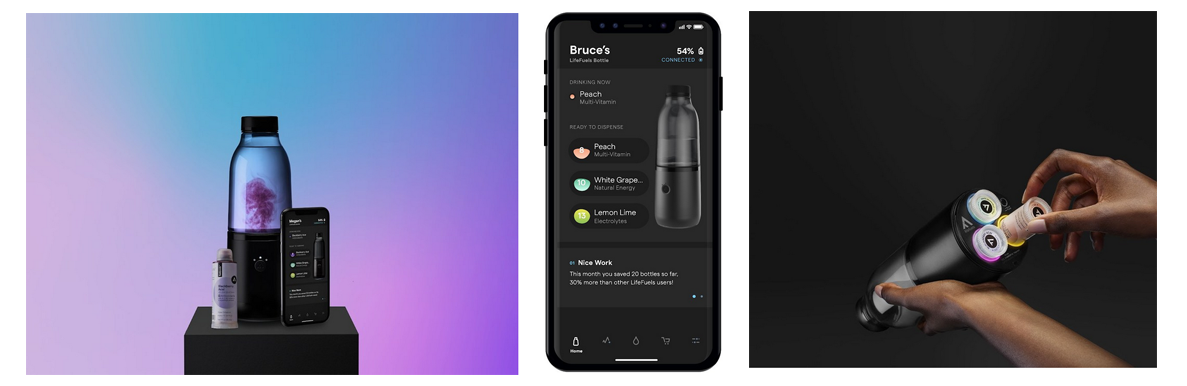
Bulletproof Coffee is continuing to take a deliberate tack with its RTD coffee line, as it balances promise of that segment with retail synergies that occur when co’s broader portfolio spanning product 5 categories gets focus. That’s resulted in unusual spectacle where some of RTD’s imitators, notably Kitu Life Super Coffee, seem to have lapped Bulletproof’s single-serve coffee in some markets. But if Bulletproof execs are perturbed about that, they’re doing a good job of disguising it, saying they’re remaining discriminating in retail partners they select and keeping focus on product groupings that also include nutrition bars, protein, oils and bagged coffee, as Bulletproof’s Seattle-based vp/gm of retail sales, Pat Brown, explained at Expo East last week. On RTD side at Baltimore show, co was showing core Cold Brew Bulletproof Coffee in Original, Mocha, Vanilla and Caramel flavors at $3.99, along with Collagen Protein extension in Original, Dark Chocolate and Vanilla Latte flavors at $4.99, all featuring co’s Brain Octane MCT oil and grass-fed milk but no sugar. Also on view was co’s initial RTD entry, Fat Water, tho that’s getting little emphasis currently.
Over past year we’ve offered fair amount of coverage of Super Coffee, which seems to be racking up high velocities in Northeast markets and is aggressively expanding. Here’s update on Bulletproof and another imitator, Austin-based Picnik, from our encounters at Expo East.
Bulletproof Keeps It Balanced Among RTD Coffee, Bagged Coffee, Oil, Protein, Bars; Eyes Bottle for Coffee, but DSD Not in Immediate Future Playing in 5 categories that offer deep synergy at retail amid sea of bright-orange branding, Bulletproof finds itself in funny position on RTD line that prompted flock of imitators: it’s forced to take restrained tack because DSD isn’t really an option right now, given need to maintain balance with its nutrition bars, protein, oils and bagged coffee. That’s because focusing on Bulletproof product family has been very effective, Brown argued. At retailers where broad portfolio is fully executed, each platform ends up netting out at about 20% of total sales, even while individual sector plays maintain spot in top quartile of their category. (Brain Octane remains #1 oil, while Protein is #2 behind Vital Pharmaceuticals, while the coffees hold their own vs established brands like Peet’s.) So far, the brand’s regular retail promos in Jan and Jul don’t just spike sales for duration of event but substantially raise baseline, as buyers of the RTD coffee, for example, discover the nutrition bars. Shopper who picks up coffee, Brain Octane oil and butter quickly hits $45 register ring, Pat noted. That makes for ample immediate promise at grocery. Given tuff contracts proffered by many DSD houses, Bulletproof is staying away for now, tho it’s definite possibility down the road, Brown indicated.
Since launching just 3 years ago, the RTD coffee has gotten packaging and recipe tweaks intended to make it drinkable on daily basis. It’s out only in Tetra Paks but at behest of 7-Eleven and other retailers, co is considering a bottled version. By now it has 20% ACV, with major natural food presence tempered by less developed presence in conventional grocery, where brand is intent on finding “motivated partners,” said Brown, a WhiteWave and Vega vet with Bulletproof 2 years now. Brand has entered about 20% of CVS drug chain, focusing on so-called health hub locations. About 100 stores will get full Bulletproof set. Nutrition chain Vitamin Shoppe, meanwhile, has been establishing discrete keto sets with multiple brands including Bulletproof, which also gets some coolers. On conventional grocery side, Hy Vee in Iowa serves as illuminating example: at chain that maintains in-store dieticians and natural-food sections, brand has racked up some of its highest $$ per store, showing that heartland location is no limitation for brand. Entrée into Kroger chain was via QFC banner in Pac NW, where special 3-foot sets outsell other stores by 3X. It doesn’t hurt that most chains have at least one Bulletproof evangelist within exec ranks, easing chance to make pitch. So far, RTD coffee works best in cooler, so there’s no plan to add multipacks or club packs yet.
Tho co spends behind marketing and digital media, founder Dave Asprey’s podcasts – which preceded the actual CPG product lines – is major tentpole for brand, drawing 2 mil listeners per month. Among its other efforts, Bulletproof maintains 3 coffee shops, led by flagship in Santa Monica, but mainly as a branding platform rather than base for extensive café chain as is case with rivals like Stumptown and Toby’s Estate. As for bottled Fat Water entry, that remains available, but for now is getting limited push, Brown said. It’s in retailers like Erewhon, Wegmans and Whole Foods’ Northeast and Southern Calif divs.
Picnik Eases Back on RTD Coffee to Emphasize Expanded Creamer Line Another earlier entrant in Bulletproof sweepstakes, Austin-based Picnik, was showing its creamers but the RTD coffees were not visible at booth (tho hidden stash was available to those who requested item). But with coffee having turned into a dogfight, Picnik is riding big interest in creamers, broadening line from Original entry intro’d last year to at a Vegan Creamer made with coconut cream and MCT oil and Collagen Creamer made from grass-fed collagen and MCT oil. All 3 are unsweetened. They’re packed in 25-oz cartons that got a reskinning from coat-of-a-thousand-colors motif still employed on RTDs in favor of subtle one-color palette keyed to flavor. Both new entries have been accepted at some Target stores this fall even as the Original entry is about to roll out thru Whole Foods, said Jennifer Seifter, musical theater pro based in NY who was stepping in for her sister, founder Naomi Seifter, who was having baby back in Austin. Giant and Sprout’s chains also are picking up trio of creamers.
As for the RTD coffees, they’re holding their own at retail partners like Sprout’s, HEB, Natural Grocers and Central Market, but are getting less emphasis in what’s become highly cluttered category, Seifter indicated. Picnik, recall, is CPG spinoff of restaurant in Austin, in past year backed by private-equity shop KarpReilly.
Conventional energy players haven’t been seen much at expos east and west because of their ingredient lists, but Red Bull North America was maintaining a presence at Expo East to push its line of canned organic sodas. After test phase, they broke in Sprout’s Farmers Market chain in Apr and headed into broader distribution in Jun, via broadliners KeHe, UNFI and DPI rather than energy drinks’ DSD network. Out in Simply Cola (“organic & crisp”), Bitter Lemon (“organic & tart”), Ginger Ale (“organic & spicy”) and Tonic Water (“organic & dry”), they go out singly at 2 for $5 per 8-oz slim can, promo’d at 2 for $4 and in 4-packs at $6.99 promo’d at $5.99.
Nestle-owned Chameleon Cold-Brew has taken plunge onto shelf-stable realm with 3 lines of 8-oz slim-can items priced at $2.99. Hitting shelves recently have been Whole Milk Latte and Black Coffee, each with 2 sku’s, and launching in Jan will be Oat Milk Latte, also in 2 initial sku’s. All are certified as organic. The Black Coffee is out in Black and Churro flavors, while the Lattes have debuted in Original and Cinnamon Dolce entries. They’ll enter Whole Foods next month and also are headed toward Target chain. Due in Jan is Oat Milk Latte in Dark Chocolate and Maple flavors.
Longtime bev watchers might have done a doubletake at World Finer Foods/Liberty Richter booth at Expo East when show opened yesterday: manning Beyond Brands contingent of entries was Steaz cofounder Steven Kessler, who’d been known to have been estranged for several years from Eric Schnell, his onetime Steaz partner who now runs BeyondBrands incubator. Now they’re back on same page and Kessler has departed Brands Within Reach, which was just acquired by New Age Beverages, to put the band back together with Schnell, who launched BeyondBrands a few years ago with his wife Marci Zaroff. Steven has signed on as chief sales officer for both Beyond Brands and the Mood 33 cannabrand in which it’s key investor.
And that’s what duo was selling at Expo. Mood33 now is moving beyond THC line sold at Calif dispensaries to offer 6-flavor line of Hemp-Infused Herbal Tea packed in striking resealable straightwall aluminum bottles. The line offers 33 mg of hemp extract per bottle in flavors like Energy, Passion and Wellbeing, at $5.99 SRP. Tho partners were still showing lab samples at show, they expect to be shipping by late Oct. At time that hemp supply chain still is questionable, they’re using Evo full-spectrum hemp as source, which is grown to organic standards in Colo and SD, thus laying groundwork for organic certification once regulatory apparatus is in place for that. Schnell noted that light can have deleterious effect on CBD, making aluminum bottle preferable pack on practical as well as aesthetic grounds. Schnell and Kessler will target natural and specialty stores, but are open to right c-store and drug partners too. DSD is likely to be part of distribution mix in the right markets.
The entries had remarkably similar flavor and mouthfeel to Steaz Green Tea, which Eric said is no accident as they aim for drinkability. Most of the entries have 3-6% juice and organic Energy is only caffeinated entry, with 133 mg of caffeine from guayusa, green tea and coffee beans. Organic cane sugar is sweetener, with entries coming in at 60-70 calories per 12-oz bottle. The other entries are Passion (passionfruit, hibiscus, lime), Joy (peach, yerba mate), Wellbeing (blueberries, reishi mushrooms, hops), Peace (watermelon, mint, basil) and Calm (lavender, chamomile).
Meanwhile, the THC-based line is making progress, hopping aboard trucks of Caliva 3 weeks ago as first bev to make cut at preferred dispensary distributor. Caliva, of course, is co that bought Zola, meaning Schnell and Kessler are working with Chris Cuvelier and his team there on building mfg facility that can handle range of bevs. Schnell and Cuvelier keynoted at Cannabis Drinks Expo in SF last month.
Great Point Brands, Dallas-based private-equity shop that’s invested in cluster of Austin-based natural plays, has revved innovation accelerator as it seeks to deal with vagaries of cold-pressed juice and kombucha categories and cold-brew coffee clutter.
Perhaps most extensive work has occurred at Daily Greens cold-pressed juice brand, which like Suja and other segment players has had to contend with many consumers’ recent rejection of sugar, even harnessed in interest of nutritious organic line. So it’s tilting core line more toward functional positioning, rebranding ades line under Farmstand name and launching Daily Probiotics and Rama butterfly tea brands, said Jerry Williams, who operates Great Point Brands with his former Dr Pepper Snapple colleague Gil Cassagne.
Core brand emphasizes functionally oriented entries under names like Elevate, Vitality and Harmony. What had been Green Ades extension now will be broken out as its own brand, Farmstand Lemonade, using monk fruit extract to offer low-calorie entry with from 1 to 6 g of sugar, 15-45 calorie range. It’s out in Original, Black Cherry, Orange Turmeric, Blue Jicama and Strawberry Ginger flavors, augmented with ingredients like blue-green algae and chlorella powder. Lemonades never really belonged in produce section anyway, Williams noted. Sugar-free Rama (Malaysian word for butterfly) builds on antioxidant-rich butterfly blue tea that’s popular in Thailand and Malaysia, offering 12-oz bottles of cold-brewed tea style in Zen (containing lavender, chamomile), Glow (rose petals, hibiscus flower), Boost (spearmint, ginseng, tulsi) and Restore (dandelion root, ginger root) flavors. Daily Probiotics Morning Greens, whose graphic treatment makes it more familiar as Daily Greens trademark (tho front panel only uses “D/G” emblem rather than full name) offers 1 bil cfu’s per 12-oz bottle in Orange, Pear and Pineapple flavors. Sweeping revamp comes as co has quietly exited self-production in East Austin (BBI, Feb 19) and also shed tie to WhiteWave, once a minority investor. Founder Shauna Martin remains closely involved in building brand.
Live, kombucha player whose founder Trevor Ross has moved on from active role, has been mainly riding its year-old 12-oz canned Probiotic Soda, zero-calorie CSD that employs monk fruit as sweetener, rather than the stevia employed by category leader Zevia, in Cola, Root Beer, Doctor, Lemon Lime and Ginger flavors. And Cuvee Coffee, launched by Austin coffeehouse operator Mike McKim, who’s still in operational mix, is broadening range of 12-oz canned nitro cold-brews, which now include likes of Vanilla, Horchata, Mocha, Banana and Lemon Ginger Snap. The widget can lends creamy overtone to liquid that helps minimize need for dairy, Jerry suggested. Unusually, it’s incorporated its Hemp sku as line-priced item at same $3.99 SRP, making for uncommonly approachable hemp entry price-wise, tho broadline distributor UNFI so far has refrained from picking it up until regulatory climate is clearer. Cuvee also has taken 3 best-selling roasts of its whole-bean coffee into ground-coffee format.
Retired Tetra Pak magnate Hans Rausing died at his estate in England at age 93. The Swedish-born Rausing had helped his father, Ruben, commercialize invention of engineer Erik Wallenberg starting in 1951, joining co upon completing education at Univ of Lund and rising to ceo thru 1995, when he sold his share to brother Gad, as NY Times reported. He relocated to UK to avoid Sweden’s high taxation rates.