


Beer Marketer's Insights
High Grade, Anheuser-Busch distributor in central NJ that’s shown deft touch on NA side via its Briar’s unit, has expanded to northern part of state with NA portfolio as Drink King abruptly shut doors. Among brands being distributed by High Grade in new territory are Bang Energy, Polar Seltzer, Voss Water, Kitu Super Coffee and Reed’s Ginger Brew, drawing from warehouses in Brunswick and Warrenton to service such populous areas as Passaic, Essex and Bergen counties earlier served by Drink King and also-exited JD. Drink King, operated by former Red Bull exec Peter Strahm, once boasted fleet of 30+ trucks across NY and NJ but last fall retreated from NYC side of Hudson River after losing key brands like Sparkling Ice in that market (BBI, Sep 20). On NJ side, it retained Ice while recently adding Bang Energy. But that apparently wasn’t enough to sustain operation, and it closed down abruptly in past 2-3 weeks. (Sparkling Ice in that territory went to Canada Dry NY, a Honickman operation.) High Grade, part of informal NIDA alliance of indie Northeast DSD houses, played key role in igniting of AriZona Iced Tea in early 1990s and has helped incubate host of other successful brands while maintaining A-B portfolio and building extensive wine & spirits portfolio, too. No comment yet from Strahm, who told us he’s currently immersed in activities related to the closure.
Red Bull Exit, Bang Emergence Redraw Some Maps in New England Termination by Red Bull of longstanding partners Atlas in Worcester, Mass, and Burke in Boston and emergence of Bang Energy has redrawn some other DSD maps, too. Both former Red Bull houses that were terminated without cause have picked up fast-growing rival Bang, with Atlas extending its footprint to western part of state for Bang, while Burke has agreed to provide Bang coverage across Rhode Island, we hear. Like High Grade/Briar’s, Atlas is a member of the 9-state NIDA alliance, along with houses like Metro in Philadelphia, Big Geyser in NY, B&E in Conn and Farrell in Vermont, but Burke isn’t.
Sprig, an early entrant into CBD sector, has enlisted extensive roster of DSD partners, many of them Bud houses, but has eased up for now on geographic expansion as it dives deeper into existing markets. To sharpen focus, it’s dropped dispensary-targeted THC line early in year, while also moving in core LA market from LA Distributing to the much larger Haralambos Beverage. And it just brought aboard Presence Marketing as national broker, riding that co’s methodical, progressive stance on CBD. It’s readying some new products that it’s not ready to discuss yet for Q4, and is tweaking branding. One likely change: move away from “soda” as descriptor, given poor connotations of word, not to mention fact that 3 of Sprig’s 4 sku’s are sugar-free. Co has been funding its growth via incremental raises, with last one completed in Q1 bringing cumulative total to $4 mil, but hasn’t yet set done seed round or Series A. Sparkling line is packed in 12-oz cans, contains 20 mg of hemp-derived CBD and is offered in Citrus Soda (in cane sugar and zero-sugar versions), Lemon Tea and Melon Soda flavors at $3.99 SRP.
Tho only 4 years old, that’s enough to make Sprig pioneering entrant into cannabis bevs, as he noted at BevNet’s first cannabis forum last Dec (BBI, Dec 3), so we reached out to cofounder Michael Lewis to see how he’s navigating tricky shoals of what’s still a highly unsettled business, with seemingly contradictory initiatives emanating from regulators at local, state and federal levels. His experience is particularly interesting because he’s sticking with CBD on label, rather than using “hemp” as safer euphemism, and offering substantial amount, 20 mg, compared to 10 mg in lots of rival entries priced higher than his.
Overall, Lewis said co is at point where it’s balancing its aggressiveness in expanding ahead of rivals with commitment to building good velocity story in the markets it enters. For now, that generally means easing up on geographic expansion in favor of “blocking and tackling.” So his travel sked has slowed a bit from frenetic first quarter, where he sought to get Sprig brand in front of as many distributors as possible, even if he suspected time wasn’t right to ink an actual contract. Its first-mover instincts have proved sound, as later arrivals are finding distributors standing pat with current portfolios, at least until regulatory climate clarifies. Some DSD partners report to Lewis that they’re approached by 2-3 brands every week.
So how’s the CBD identity playing out? There have been tradeoffs, as Michael readily admitted, such as when brand’s inaugural retail partner, Bristol Farms in SoCal, got cold feet about designation. So far, major chains are waiting on sidelines, with his contacts “champing at the bit” to get involved but waiting for greenlight from their sr mgmt, which remains skittish about environment in which various govt entities are liable to raid stores and clear their shelves of CBD items. Even so, they advise Sprig to be ready to respond to purchase order within a matter of weeks if regulatory clarity emerges and they hit “go.” In meantime, tho going out as hemp may ease some barriers, Lewis feels that can be disingenuous, since it’s the CBD that’s attraction and that justifies the price point. Until the big chains come around, Spring is entering indies and smaller chains, including Key Foods in NY and potentially Morton Williams. As reported this week, working with SAS it’s entered Earth Fare chain in Florida, which is offering line in cooler, on warm shelf and via floor displays (BBI, Jul 17). Lassen’s Market chain in SoCal has encouraged aggressive demos at all 15 locations, with Silver Lake location in LA depleting 20 cases per week. The 22-store Rosauer’s Supermarkets chain in Pac NW also has been ardent advocate of brand, with sales there ticking up sharply after demos. And 90-store Spec’s liquor chain in Texas has been ordering by the pallet every other week.
“We’re comfortable with the package and label, but if there’s a problem and needs to be a change, you can be sure we’ll make it immediately,” Michael told us, adding that he’s assured trade partners that Sprig can be trusted and nobody will get stuck holding the bag if changeover needs to happen.
On wholesaler side, co has enlisted extensive roster of Anheuser-Busch houses, including Double Eagle in Florida about a month ago and many houses in Northeast: entire Bud network in Maine, Dana in NY’s Hudson Valley, Farrell in Vermont, some in Rhode Island. All of Mich is covered via Bud network, and Lakeshore will come aboard next week in Chicago. In NY Sprig has stuck with small house Gold Coast, which has reach mainly among influencer accts in lower Manhattan and Brooklyn, and subs out other territory, performing very strongly for house its size, in Lewis’ view. Move from LAD to Haralambos occurred in Feb. Brand also moves thru some indy Pepsi bottlers, including one who performs copacking.
There are signs that Sprig’s relatively aggressive $3.99 price is setting standard for other brands, which are coming down or stepping up incentives. Since Sprig offers 20 mg of CBD to the 10 mg offered by several key rivals, that would seem to create a margin challenge, but Lewis said co is benefiting from 30-40% price decline of CBD isolate from $75-100 per kilo a year and a half ago. Another area of focus: testing, as marketers aims to deliver the dosages of CBD they promise, a task that can be complicated by product stability issues. Labs must develop adequate methodologies, too.
In high-end bottled water, is Essentia the new black? Coca-Cola’s Smartwater brand, which in recent months has launched alkaline rival called Smartwater Alkaline 9+pH, seems to have rapidly undertaken a reskinning of plastic bottle that renders it a bit more Essentia-like in adopting black & white tonality rather than original blue tonality that stayed in synch with core brand’s trade dress. Essentia, of course, has striking graphic treatment featuring white lettering against pitch-black background with bright red “E” at bottom, and its dominance of alkaline segment seems to have made it default color for wannabe brands that enter under names like Supreme or retailers’ private labels. (See photo below, sent our way by distributor contact.) Smartwater’s twin extensions into antioxidant-rich and alkaline segments seem to be mainly playing on West Coast so far, together scoring about $24 mil in sales, not quite enough to offset $25.8 mil decline on core brand, per data that’s been shared with us. So KO seems to be reacting quickly to carve out identity that’s more distinctive from Smartwater electrolyte offerings and more in synch with alkaline market leader. 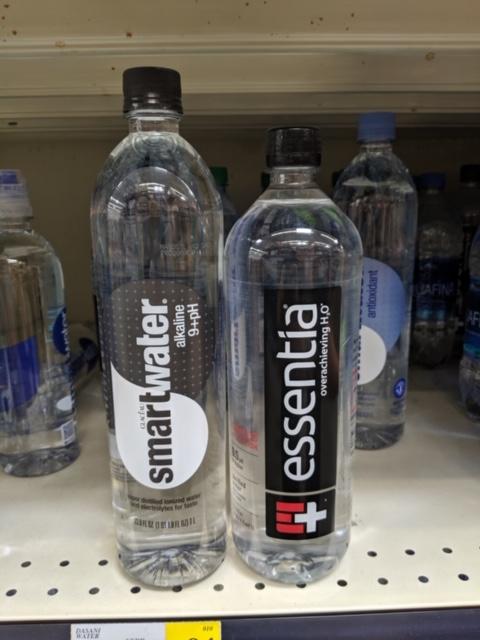
New PepsiCo ceo is proving more willing than his predecessor to write big checks, committing $1.7 bil in cash and debt to proposed acquisition of South African food/bev giant Pioneer Foods. That’s premium of 56% to Pioneer’s trading range over past 30 days, decisively ending period inaugurated by prior ceo Indra Nooyi in which PEP looked warily at deals of greater than “bolt-on” scale of $500 mil or so. Tho ebitda multiple is 11X, RBC’s Nik Modi noted that “PFG’s margin profile is currently trending below its historical norm driven by commodity-related supply chain issues stemming from excessive heat.” Deal gives PEP stronger foothold in continent accounting for 17% of world’s population, he noted. So “this acquisition is a testament to the fact that (Laguarta) is serious about reinvesting behind the business to drive future growth and is willing to be more active with M&A for the right opportunities.” Morgan Stanley’s Dara Mohsenian offered this view: “We see value for PEP from getting access to Pioneer Food’s distribution and manufacturing network in South Africa to expand the availability of Pepsi/Frito/Quaker products in the country longer-term as consumers' disposable income increases, particularly in informal retail outlets, which represent an estimated ~30% of the country's retail footprint.” He reminds that Pioneer served as Pepsi’s bottler in region from 2006 to 2014, meaning buyer is likely to encounter few surprises as it moves toward closing deal. Pioneer’s brands include likes of Weet-Bix, Liqui-Fruit, Ceres, Sasko, Safari, Spekko and White Star. In statement, Laguarta termed the 2 businesses “highly complementary” and noted that both cos have made big commitment to investing back in communities and otherwise operating in purpose-driven way. To maintain focus on region PEP is creating new geographic operating unit, Sub-Saharan Africa, led by Eugene Willemsen, previously evp global categories & franchise. Unit will report financially into existing Europe Sub-Saharan Africa sector. Wells Fargo’s Bonnie Herzog estimates the deal will boost PEP’s Sub-Saharan African biz from $500-600 mil currently to about $2 bil.
Coca-Cola is revving up its Costa Coffee Ltd acquisition as a RTD platform, with Coca-Cola Hellenic Bottling Co saying it will bring the drinks to at least 10 of its 28 markets next year. The roster of anticipated markets includes Bulgaria, Greece, Hungary, Poland, Romania, Russia and Switzerland, Coke HBC said in statement, giving bottler a play in multibillion-dollar category growing by 4% annually in its footprint. Costa, of course, is UK-based café operator with big footprint in Asia that was acquired by KO in Jan. Group of “double espresso shots” shared with BBI by Coca-Cola labeled as being from Coca-Cola European Partners included Straight Forward Americano (15 calories), Smooth Sidekick Latte (105 calories) and Sweet Sidekick Caramel Latte (95 calories), all packed in 250-ml slim cans in deep red shade flanked by color bands keyed to flavor. They’re all based on Costa’s Signature Blend, produced since 1971, as can copy romances. Line debuted in CCEP territory, which includes Costa’s UK base.
With its fast-igniting performance energy brand Bang that’s drawn a slew of copycats, VPX has shown it knows how to incubate a new sector. Is Florida-based co ready now to dive into CBD sector? It seems to be planning announcement in coming weeks of 16-oz sparkling full-spectrum hemp brand called Stoked that, in concession to uncertain regulatory climate, keeps the letters CBD off front panel – but includes bright-red rendering of 5-leaf cannabis plant over the “O” in brand name. New line isn’t overtly branded as Bang, maybe out of desire to protect cash cow from vagaries of CBD segment, but VPX (also Vital Pharmaceuticals) in past day or so has been blasting out teasers on Bang social media flagging new entry, which is described as containing no sugar or calories and produced using ingredients called ValeRx, Canablast and Nitro-Jack. Images show Bang-like flavor names like Mango Bango, Strawberry Blonde and Frose Rose. “Bang Energy continues to show its brilliance by previewing the release of its upcoming new hemp carbonated beverage STOKED,” reads one typical exhortation. Co indicates it’s planning to show Stoked at USA CBD Expo in Miami Beach, Fla, running Aug 2-4.
Organic-food supplier SunOpta added pair of PepsiCo vets to its board. Joining the Toronto-based co is 31-year PepsiCo vet Leslie Starr Keating, who rose to svp of PepsiCo Supply Chain before heading to Advance Auto Parts for a year and a half and then retiring. Also aboard is Rebecca Fisher, who served as PEP’s svp for human resources before retiring last Dec . . . Conagra Brands has moved its Reddi-wip brand into coffee creamer category with pair of dairy-based entries dubbed Barista Series: Nitro Creamer that can add texture to drinks and Sweet Foam that adds layer of foam atop drinks, a bit like Starbucks’ in-store cascara foams. Both are packed in brand’s familiar spray-top cans, in deep brown hue. “Your local barista will miss you,” marketing materials note sentimentally . . . Chicago Cubs’ Kris Bryant took batting practice in downtown Chicago last week, hitting balls hurled by Rookie of the Year Henry Rowengartner into Chicago River to herald launch of 2d commemorative Red Bull can featuring his likeness. Limited-run promo launched this week in 8.4-oz and 12-oz sizes across Chicago metro . . . Absolut Vodka is latest alc brand to take a leaf from NA brands like Spindrift in touting its use of real fruit for flavoring, with new line called Absolut Juice that’s intended to fill “sip-with-a-spritz” occasions. Containing the base vodka plus 5% fruit juice, new entry is offered in Strawberry and Apple flavors and comes in at 99 calories or less per serving – 20% fewer calories than glass of rosé wine when served as a Juice & soda, co notes. SRP is $19.99.
Read the labels. That’s gist of Consumer Reports analysis of 40 RTD cold-brewed coffee entries from 7 mfrs that ended up steering its readers to Califia Farms Black & White Unsweetened Cold Brew Coffee with Almondmilk and Chameleon Cold-Brew Black Coffee as preferred choices. Tho cold-brew’s healthier image derives from unsweetened black variety used as base in coffee shops where style originated, RTD versions are different story, review org warns. “When you start looking at bottled versions that have added sugars and cream, milk, or even plant milk, the calorie count can start to climb,” per CR. “Even ones that say ‘not too sweet’ can have a fair amount of added sugars per bottle. And more than half of the bottles CR looked at had ingredients that contained sodium—some with as much as potato chips,” as with Starbucks Cocoa & Honey flavor with 170 mg of sodium per 11-oz bottle. CR encourages consumers to make their own at home, noting it stays fresh for 2 weeks rather than deteriorating immediately as conventional iced coffee does. Net net: review offers further awareness boost for cold-brew style, but projects considerable skepticism about convenient RTDs lately invading store shelves.
SAS Sales & Marketing has been slowly enhancing its consulting and distribution offerings in So Fla, winning authorization as vendor at several key chains and expanding staff to 7. Recall that co whose initials stand for founders Susan and Andy Stallone (he helped build out AriZona Iced Tea brand in Fla in early 1990s) started by offering early-stage brands assistance with strategy and sales calls before building out modest distribution arm in 2017 as way to help its clients garner some in-market traction before they approach established distributors about coverage (BBI, Nov 14 2017). In discussion with Andy yesterday, longtime bev operator discussed SAS brand lineup that includes Rise Coffee, Sprig CBD, PLNT Water, Phocus and Just Chill, serviced by team that includes Andy and 6 colleagues, 4 of them in Miami area and 2 working west coast inland to Orlando. It draws from warehouses in Boca Raton and Tampa. After initially focusing on indie stores, SAS lately has been able to win authorization as vendor at several key chains: Lucky’s, Earth Fare, Nutrition Smart, Earth Origins Market and Chamberlin’s Natural Foods. That’s been helpful with clients like Sprig, which had won chainwide nod from Earth Fare but boasted no DSD partner to support chain’s Fla stores. So SAS has filled gap. SAS has also developed solid working relationship with broadliners UNFI and KeHe, which recognize it as incubator that can help develop enough momentum for a new brand to be worth a bet. And SAS is happy to team with established distributors, such as Bud house Double Eagle, to broaden coverage for clients, as it does now for Sprig.
Tho regarded as influencer market that’s receptive to new concepts, South Florida has been a headache for innovative NAs since indie shop Sand Dollar went under years ago after losing Red Bull brand. Beer networks, particularly Bud houses, have been tuff to crack by NAs. Lately, tho, that’s changing, perhaps as outgrowth of slowing beer trends. “The climate has changed” on Bud side, Stallone reported, with some Bud houses establishing separate NA divs to give those brands greater focus. They’ve proved particularly interested in performance energy brands like Bang, C4 and Celsius (we reported yesterday that Celsius is entering all but 3 Bud houses in state). There’s also “tremendous interest” in CBD, tho most are standing pat until there’s greater regulatory clarity. One exception is Double Eagle, carrying Sprig entry in Palm Beach, Broward and Dade Counties.
Bev Buzz Survey Finds Hot 4th Sales, Rational Promos; Coke Humming, but Pepsi, KDP Encounter Doubts
Despite some grousing about bad weather, c-store retailers told Wells Fargo Securities that their bev portfolios performed well during Q2, tho among major suppliers Coca-Cola drew the most plaudits for deft execution vs a PepsiCo that was seen as overly reactive and a KDP that’s seen as cutting back and still smarting from loss of Fiji Water and Body Armor brands. Promo environment was reported as being rational, performance energy drinks led by Bang continued to spark excitement and several retailers seemed pumped about Gatorade Zero prospects.
“Feedback from our retailer contacts,” in survey of execs operating 15K+ c-stores across US, “was upbeat regarding Q2 & 4th of July trends, as strong consumer fundamentals and favorable weather got the early summer bev selling season off to a strong start,” wrote Wells Fargo sr analyst Bonnie Herzog. Total bev sales “were up a strong +4.8% in Q2 (ahead of +4.0% in Q1) and up a robust +6.1%,” for July 4 holiday. Non-alc bev sales also had solid gain Q2, up 4.4% vs +4.1% in Q1 survey. As another positive to go along with solid sales, “the promo environment is very rational, with non-alcoholic beverage promos up only 1.5% y/y on 7/4,” noted Bonnie. She noted Monster Energy promos “were an outlier,” given co’s BOGO promos in Jun. Herzog’s more authoritative look at environment jibed with our anecdotal perusal of some grocery fliers for holiday weekend, which suggested aggressive but rational stance on pricing (BBI, Jul 3). We report on survey in depth because it offers unadulterated glimpse in key impulse channel of views of retailers, who rarely express those views in public.
Upbeat on KO, Especially Body Armor; Try Not to Kill This Golden Goose, One Retailer Pleads; Costa Coffee Not Comin’ Soon? Coca-Cola sales rose an estimated 2.4% in Q2 in c-stores, “in line” with 2.2% Q1 gain. “Retailers were most upbeat about Body Armor,” noted Bonnie as it “continues to grow well ahead of the category and take share from Gatorade.” One retailer expressed concern that Body Armor momentum isn’t interrupted: “Body Armor is the greatest brand that they have and I hope they do not kill it like they have destroyed Zico, Honest, Smartwater and Vitaminwater. Stop & Shop is running 79-cent sale for July 4th on these brands. I hope they do not do this to Body Armor.” Meanwhile, retailers so far haven’t heard anything about anticipated RTD coffee entries from recent Coke acquisition Costa, a major player in UK and Asia. “No plans have been communicated, not sure if we would carry,” said one survey respondent. One expressed eagerness to see Coke Energy launch. Meanwhile, transition to indie bottlers via refranchising has complicated promo efforts, as one respondent noted. “Coca Cola continues to be very limited on promotions, primarily due to all of the franchise bottlers. Our store network crosses 4 franchise bottlers that all have a different strategy to market, want to activate different promotions and choose their own packages to carry. In an effort to remain with a consistent set across all of our sites, it has limited the promotions with Coca Cola.”
PepsiCo ‘Results Disappoint Again’ PEP c-store sales “were up a very modest +0.4% in Q2,” down from +1.2% in Q1, reported Bonnie. While some retailers were positive on prospects for Bolt 24 and Gatorade Zero extensions, “others remain concerned about PEP’s overall beverage strategy, innovation pipeline and packaging,” she added. “A full 60%” of retailers in survey reported they don’t see an improvement in sales, “despite stepped-up advertising & investment spend, suggesting to us that it might take PEP a very long time to undo years of persistent underinvestment in PEP’s sales in their stores.” Other suggested KO continues to out-execute PEP. “Pepsi was reactive and too late for summer planning after seeing/hearing what Coke had in the works,” wrote one.
Muted KDP Results Keurig Dr Pepper sales rose an estimated 1.3% in Q2, just a tick ahead of +1.2% in c-stores in Q1, “but a significant deceleration from +3.3% in 4Q18,” as retailers “remain disappointed about the loss of Body Armor and Fiji” from portfolio, per Bonnie. That loss “is still stinging,” commented one retailer. “KDP seems to be in a stall. They are shifting folks trying to maximize and gain synergy to recoup the investment made,” added another. While one retailer gave kudos for “great innovation with Forto’s and Peet’s RTD coffee,” another complained that KDP “lost Core water authorization in Whole Foods and several other chains” and is also “struggling with their sugary Snapple brand.”
Solid Outlook on Energy; Hot Bang Keeps Disrupting Energy drink sales “grew by a robust +10.1% y/y this 4th of July, led primarily by emerging brands – which were ahead of both Red Bull (+7% y/y) and Monster (+6.4% y/y), noted Bonnie. Retailers are bullish on category, now anticipating full-yr 2019 growth of +7.8%, up from +6.6% in Q1 survey. By co, retailers expect Monster to grow 4.8% for full yr vs +6% for Red Bull and +11.8% for “others.” There is continued optimism for Bang: as one retailer put it, “Bang in Q2 still continues to perform well & we are still growing sales in energy month after month because of it.” “Bang has seen great growth launching in our stores, grabbed 9.5% share of the energy category,” wrote another retailer. While Monster’s new counter to Bang, Reign, seems to have slowed Bang a wee bit and may hold appeal to some consumers for its less-sweet recipe, some are wary that BOGO-led intro strategy is sustainable. “Brands are not built with Bogos,” warned one. “Monster’s dollar store strategy is going to crumble like a deck of cards.”
Retailers cited the energy players, mainly MNST, as providing the best innovation in Q2. MNST was cited by 33.3% as doing best with new innovation, up from 20% in Q1, and ahead of Bang (26.7%) and Red Bull (20%), while KO, PEP and KDP were each rated below 7% by retailers. Another positive for energy segment: survey found c-stores upped shelf/cooler space “significantly” over last few years for energy category, pushing allocation from 17% up to 32% currently. That said, retailers indicate they don’t plan to further expand space for category, and in fact project it to be down a bit, to approx. 28%, a few years from now. This at time, recall, that those in performance energy space, including Monster with Reign, have been hoping retailers will carve out new sections for emerging segment rather than underspacing them within existing energy set. Judging by one retailer’s comments, this isn’t happening. “Monster would always stress the importance of not losing ground with Monster Green. Now they are [cannibalizing] their own shelf space and coolers with Reign.” What about forthcoming Adrenaline Shoc, via KDP system? “Another sports energy drink that will most likely source all of its volume from existing items on our shelf today,” was verdict of one respondent. “Lots of manufacturers are trying to imitate the success of Bang.”
General Climate: Kudos on Innovation for Monster, Gatorade; Shelf Sets Overcaffeinated by Now? Nestle Pressured by High-End Waters Most welcome innovations? “Make it REIGN!” exclaimed one retailer. “And Monster Mule. Gatorade Zero is delicious as well” . . . Are c-store operators starting to lose patience with stream of new RTD coffee offerings? “We already are oversaturated with RTD coffee drinks between Starbucks’, Monster’s, Dunkin’ and our private label,” wrote one. “Still small part of beverage sales to expand” . . . Growth of newer premium bottled waters is putting pressure on incumbent brands. “Nestle is panicking with their shrinking sales,” wrote one c-store operator. “They are losing sales from premium water such as Essentia and Core.” (One exec cited 50-cent deal on 20-oz Ice Mountain as response. Another comment: “We discontinued many Nestle brands to bring in private label.”)