



Beer Marketer's Insights
Since 2005, Honest Tea claims to have paid over $2.5 mil in above-market-price Fair Trade premiums to its suppliers in growing regions. Trouble is, many consumers still don’t have a handle on what that designation means. The solution: “Small decision. Big impact,” a multipronged campaign involving animated videos, out-of-home ads and “immersive” vending machines that tries to make more explicit the ways in which purchasing an Honest Tea item contributes to well-being not just of the purchasers and their families but of broader communities around the world.
The new campaign adopts soft, inviting touch via charming stop-motion animation to get across the larger notions at the core of organic Honest Tea brand, whose cofounders, Seth Goldman and Barry Nalebuff, titled their memoir Mission in a Bottle. Thus, green tea-focused spot connects animated woman’s enjoyment of flavor and well-being of the green tea to the bicycles and new roof for school that item’s Fair Trade premium brought to village near tea farm in India. “Back to you. You did that,” cheers voiceover as visual segues to Honest family shot including single-serve and multiserve teas as well as lemonade and Honest Kids. Along the way, spot also heralds lower sugar levels of brand, showing teaspoon topped with 8 sugar cubes dropping to 4.
The effort, taking general direction that Goldman and gm Clare Verdery had flagged in conversation earlier this year (BBI, Feb 1), broadens prior efforts that showed cofounder Seth ambling thru Indian tea gardens to stress brand’s roots as organic, Fair Trade pioneer. That prior effort included TV, which has dropped out of mix this go-round. In statement today, Seth noted, “Research shows that most of our consumers don’t fully understand how the fair trade model works. By featuring real examples of what Fair Trade Community Development Funds have supported – such as new bicycles and school roofs – we’re able to demonstrate the process and its impact in a simple, tangible way.”
As part of effort, brand next Tues will be installing custom vending machines at its suburban DC base as well as NY, Philly and LA, inviting consumers to vote for favorite projects among those fostered by Fair Trade USA and Organic Farming Research Foundation. Shoppers will also be encouraged to “up their impact” by paying a bit more themselves. “Choose a drink that makes a difference,” invites signage on prototype we’ve seen. Effort reps interesting twist on long-running Honest Cities campaign in which co relied on honor system at unattended racks of Honest Tea, with the takes tallied in order to calculate index of most honest cities in US. The vendors will be up thru Aug 30.
A key component of campaign is outdoor ad blitz focused on Washington, DC, NY, LA and Philadelphia, all markets where the custom vendors are going in. A Coke rep said the out-of-home mix includes digital walls, bus shelters, transit station takeovers, bus wraps, bulletins and more – including, apparently, takeovers of bikeshare docking stations, as BBI editor encountered yesterday afternoon returning a bike (see photo).
In addition to the outdoor ads, the look-&-feel of campaign will be featured on e-commerce sites and podcasts, and across platforms like Hulu, Amazon Fire TV and on-demand networks, KO said today. It also has been extended to revamped brand website, dedicated campaign landing page, electronic screens of vendors and in messaging encouraging visitors to share their #smalldecisionbigimpact. Creative agency is Partners & Spade, with Noble People doing the media buying. Legend PR is playing a part creating buzz around effort.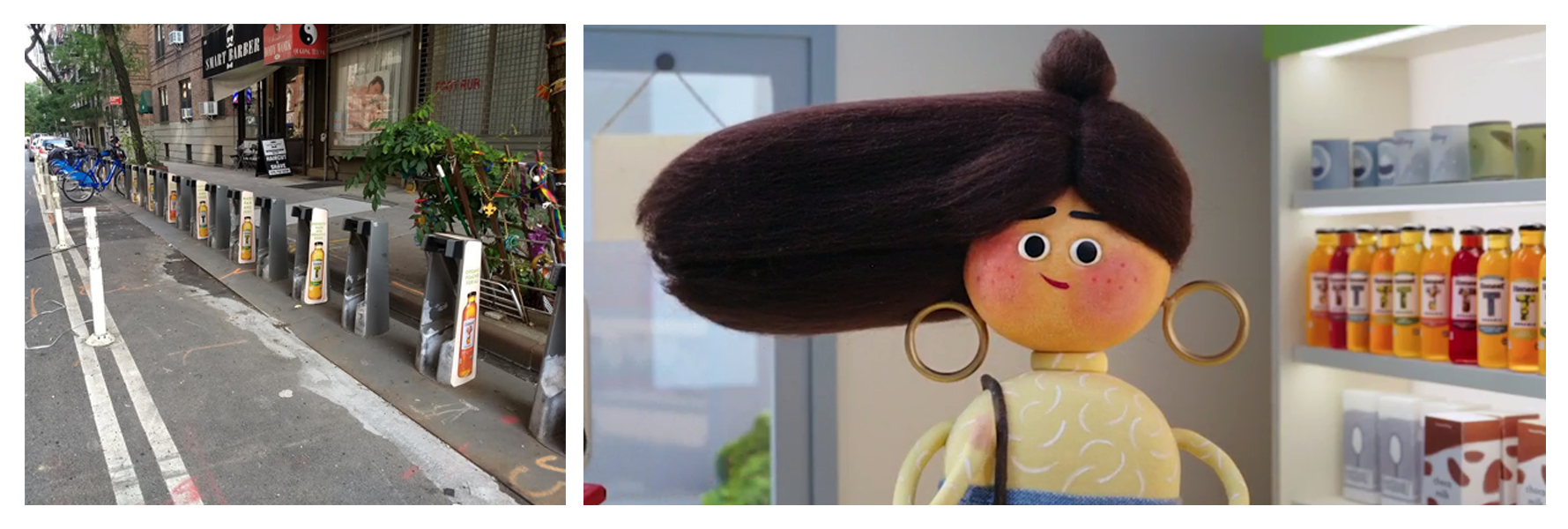
Dunn’s River Brands’ restaging Sweet Leaf Tea continues to make headway rebuilding its retail footprint, lately adding all 200 or so stores in Albertsons Safeway’s Texas div, which are picking up 4 of its 16-oz bottles and 2 of its half-gal jugs. Also aboard now, says Dunn’s River ceo Bill Meissner, are all 160 Tops Markets stores in Northeast, with 5 single-serve flavors, and 300+ Cost Plus World Market stores, also picking up 5 sku’s. Dunn’s River, of course, is NA vehicle operated by Fireman Capital and includes Tradewinds tea brand and Temple turmeric brand.
PRESS CLIPS: As Plastic Backlash Grows, NY Times Outlines Bevcos’ Efforts to Undermine Bottle Bills
NY Times this past Fri took a jaundiced view of big bevcos’ “embrace” of recycling, saying it only happens on their own terms if it’s not too costly. Story details how “for decades, beverage companies, retailers and many of the nonprofit groups they control have fought to kill bottle bill proposals across the country – with great success.” Sometimes they’ve operated thru seemingly benign front groups like Coca-Cola Foundation or group called The Recycling Partnership. Since 1987, only Hawaii has passed a bottle bill, article notes. “This year, such measures have been proposed in at least 8 states. Nearly all have been rejected or failed to gain traction,” including bill in Conn that would have expanded deposits from soda and beer to juice and energy drinks. That’s left recycling largely dependent on consumers’ own goodwill and millions of bottles and cans heading to the dump as a result. As anti-plastic backlash grows, tho, bev giants in recent weeks have made broad statements “suggesting a new openness to bottle bills,” piece notes. American Beverage Assn said that while it had opposed bottle bills “in the past,” it was “open to any ideas” that would create more recycled plastic. Story can be accessed here.
Cannabis shares moved broadly downward today in light of latest evidence of wild west nature of segment: seizure by Canadian regulator of CannTrust Holdings inventory that allegedly was grown in unlicensed rooms. That prompted quick downgrade of CTST stock by BMO analysts Tamy Chen and Peter Sklar, who were incredulous that co would allow such a breach to occur, as Market Watch reported. That’s not to mention question of where the confiscated inventory will end up . . . Meanwhile, Organigram said it’s developed proprietary nano-emulsification technology suited to both liquid and powdered bevs that delivers CBD benefits in 10-15 minutes. Tho it’s working on its own chocolates and powdered bevs for 2020, OGI said it’s seeking a “strategic partner with proven experience in beverage product development to take advantage of the liquid formulation it has developed.”
It’s mixed picture for Monster Beverage in latest national scans analyzed by Wells Fargo’s Bonnie Herzog: core brand has lost a wee bit of share but Reign is showing signs of being most explosive launch ever, albeit without putting a noticeable dent in the rival it’s targeting, Bang. Meanwhile, separate set of data we’ve seen shows slippage in NY market after Monster segued from indie house Big Geyser to Coke franchisee Liberty.
The national data first. Monster (including Reign) scored 2.8% sales growth in latest 4 wks thru Jun 29 tracked by Nielsen all-channel matrix, costing it 2.2 pts of share and off from its long-term growth rate. So brand’s strong pricing (+4.8%) may be weighing on volume, Herzog wonders. But Reign is scoring $8 mil in weekly sales, and is on brisker growth path than prior extensions like Ultra, Mutant and Hydro, even with ACV of only 41% (expected to get a bump when Walmart picks up brand next month, Bonnie believes). Of course, a BOGO doesn’t hurt either.
Among Monster platforms, both core green can and Ultra have enjoyed robust pricing that’s kept $$ sales flat, even as volume has eroded. Java Monster has lately dipped into negative territory on volume basis, tho $$ sales are up robust 6.3% for past 4 wks. Non-Monster energy brands inherited from Coke, NOS and Full Throttle, both are in negative territory on both volume and sales fronts. Among rivals, Red Bull grew sales 2.1% on flat pricing, Rockstar skidded 18.1% and Bang “moderated” 4-wk growth to 400% range on just 63% ACV; its past 52-week sales total $693 mil. Pepsi/Starbucks alliance (including Doubleshot) continue on a roll, +15.9% in $$ even with pricing edging up in 3% range. (Note that MNST execs have questioned to us the reliability of some of Wells Fargo scanner data, arguing it’s not adequately “scrubbed” to always yield meaningful result.)
Teething Pains in NY Transition Meanwhile, local data that’s been shared with us indicates that Monster is suffering predictable teething pains in NY following transition from indie house Big Geyser to Coca-Cola’s struggling new franchisee Liberty Coca-Cola, which has faced visible challenges keeping even Diet Coke adequately stocked, even at key chain accounts like Duane Reade. Nielsen’s for period 5 (May) show Monster, listed as enjoying 100% ACV, suffering 1% revenue decline to $32.8 mil, costing it 2.1 points of share vs year-earlier to 27.4, vs market leader Red Bull, up 5.2% to $75.6 mil, down 1 pt to 63.1 share. Who’s winning then? Bang, with little previous presence outside nutrition channel, has come out of nowhere to score $2.97 mil sales, grabbing 2.5 share, and Monster’s Bang fighter, Reign, has grabbed another 0.9 share, for $1.08 mil sales (that brand moves thru Liberty, moderating core brand’s share loss). Big Geyser’s trio of energy replacements have picked up some of slack: Uptime scored $952K sales in May (for 0.8 share), C4 $335K sales (0.3 share) and Celsius $208K (0.2 share). All other major brands are down: NOS (another Liberty brand) -9.4%, Rockstar -20.6%, Amp -44.4%, Bang sister brand Redline -23.6%. Fresh sandwiches may have won a bit of share in NY area energy coolers too (see photo). 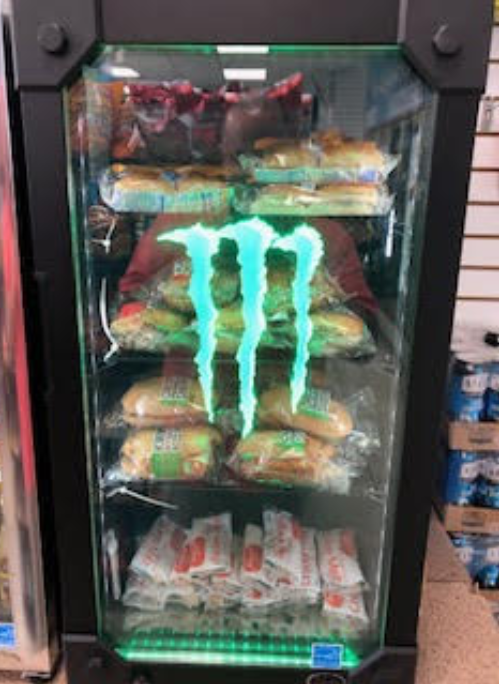
PepsiCo enjoyed net revenue growth across all its key divisions in 2d qtr, with PepsiCo Beverages North America rising 2.5%, +2% on organic basis. Overall, PEP revenue rose 2.2% to $16.45 bil, +4.5% on organic basis. For ytd, revenue is up 2.4% to $29.33 bil, +4.8% on organic basis. Operating profit contracted 10% to $2.57 bil for qtr, -2% to $4.74 bil for half, as PEP upped its marketing spending and invested more in capacity additions that will enable it to produce more of the high-margin small packs that have proved popular with portion-control-minded consumers. Even with a bit of erosion in back half of year, co should be able to notch 4% organic growth for full year, per outlook reiterated this morning by chmn/ceo Ramon Laguarta, in his 2d quarterly earnings call since taking reins from retired ceo Indra Nooyi. In give-&-take with analysts on call this morning, Ramon made case that Gatorade trademark is benefitting from key innovations, argued for extending Mtn Dew trademark into more energy occasions and took skeptical view of potential opportunity of launching a Pepsi Energy entry, arguing that consumers aren’t necessarily looking to core CSD trademarks like Pepsi or Coke for that occasion.
PEP shares enjoyed brief rally upon release of earnings, but quickly eroded. Among acknowledged “nitpicks” cited by CNBC commentator Jim Cramer was weakness in Dew, not robust strength in Gatorade and “premature” view that Bubly will be big. Among the Wall Street analysts, RBC’s Nik Modi assessed things this way: “It’s clear PEP’s reinvestment is beginning to pay dividends. Going forward we’d expect continued momentum out of Frito-Lay and slower progress out of PBNA.” This from Macquarie’s Caroline Levy: “Flat volume was a tad disappointing, but more than offset by strong price/mix.”
In core PepsiCo Beverages North America unit that represents nearly one-third of total sales, chmn/ceo Ramon Laguarta cited “sequential volume improvement” on Pepsi and Mtn Dew brands, while noting that RTD coffee was up in mid-single-digits and packaged water in high-single-digits. Co is optimistic about innovations like Mtn Dew Game Fuel, Gatorade Zero, Gatorade Bolt 24, Life WTR, Bubly, new variants of Propel and extensions within the Starbucks and Pure Leaf Tea trademarks, in environment where consumers in developed markets are clamoring for higher-value, more functional bevs and snacks and are willing to pay a premium for convenience. That portends continuation of revenue growth in what ceo praised as “very rational” pricing environment. So after period in which many have viewed Pepsi as steadily losing ground to Coca-Cola in core market, PEP “should see a return to sustained competitive performance,” Ramon predicted.
Asked about reorg in N Amer, Laguarta said co has been funneling more resources to selling front, while looking to service customers with greater nuance. Tho some execs waited until summer to undertake needed relocations of their families, that disruption is largely behind co now, and benefits should become visible in 2d half of year.
Sports Hydration Still Healthy, Thanks to Innovations under Gatorade, Propel Brands Tho Coke-aligned insurgent brand Body Armor has been grabbing headlines for chiseling away at Gatorade’s foundation, Laguarta expressed nothing to indicate that brand is in trouble, citing high brand equity and consumer engagement metrics and pointing to Gatorade Zero, in particular, among innovations that are responding to evolving consumer tastes. Tho only launched a year ago (BBI, Jul 10), Zero already is “the #1 zero sports drink by quite a distance,” helping trademark once more expand its base, with velocity up every week. For more casual exercisers, lower-calorie Propel platform has created another big opportunity in sports hydration, with consistent double-digit growth over past few years, with vitamins and other positive functionality now being added to mix. As for naturally formulated Bolt 24, out just a few weeks now (BBI, May 13), that’s aimed at needs of athletes when they’re off the field, via base of watermelon water plus sea salt and added vitamins and antioxidants. Laguarta promised further innovation under that platform. “We’re very positive about the image, the functionality we can create around Bolt,” he said. Asked about brand’s overseas prospects, Laguarta said co will continue to focus at retail in Latin America and China market but serve other overseas markets via less expensive ecommerce channel.
Mtn Dew Moving More Toward Energy Positioning, but Pepsi Energy Seems a Non-Starter; Still Happy with Rockstar as Energy Partner With Pepsi and Gatorade making progress, PEP team now is turning its attention to resuscitating Mtn Dew trademark, Laguarta indicated, upping ad & marketing spend starting in the spring and prepping substantial amount of innovation for Q4 timeframe, presumably for unveiling at NACS c-store expo in Oct. Expressing sentiment that had been internally controversial in past, Ramon said PEP plans to take advantage of brand’s adjacency to energy space by “trying to move Dew into the energy category in small steps,” along lines of Kickstart a few years ago and more recently launched Mtn Dew Amp Game Fuel that targets videogame crowd. Recall that in past this was area that execs had to tiptoe around, considering that Rockstar Energy is co’s exclusive energy partner; it was unclear whether comments might have reflected some rejiggering of that relationship to allow Pepsi more latitude in offering energy plays under its own trademarks. Recall that in scanner data, both Rockstar and Pepsi’s own Amp Energy brand have been on extended slides. We’ve reported in past that Rockstar execs had taken umbrage first at launch of Kickstart as infringing on their prerogatives, and more recently Game Fuel; of course, Coca-Cola and its energy partner Monster have similarly jousted over Coke Energy.
Discussion resumed later in call when SunTrust’s Bill Chappell wondered why, if Pepsi’s not interested in acquiring outside energy brands, it doesn’t consider a Pepsi Energy along lines of Coke’s recently released play of that nature. Laguarta said PEP will approach from many angles, including from coffee segment, sports segment and energy segment itself, at that point citing its “pretty good partner” in US and some overseas markets, Rockstar, and saying “we plan continue that relationship” and ride further innovations from Rockstar. But while major bevcos may be intent on expanding their global brands into new spaces and enjoying the high returns that brings, “If you think about the core energy consumer, it’s looking for something different than brand Coke or Pepsi can offer,” he argued, tho there may be some occasions where they consider such brands for energy needs. But “Red Bull, Monster, Rockstar, other brands have a very different proposition. I’m not saying it’s not a big business opportunity, but it’s not going to be the center of the category.”
Bubly Builds Velocity Post-Super Bowl; Adding Other Can Sizes to Mix Laguarta termed co “super happy” with Bubly performance, saying velocity has doubled since ads ran on Super Bowl earlier this year. That’s even with retailers still underspacing brand, in Pepsi’s view, subject of “a lot of dialogue.” Meanwhile, brand will not only be getting new flavors but other innovations like mini-cans and larger cans (but definitely not any plastic options). “This will be one of our next billion-dollar brands,” he believes.
Miscellaneous: SodaStream Ahead of Plan; Lavazza Deal in UK Fills Void in Starbucks Alliance Among other comments from ceo, he said SodaStream acquisition has been exceeding expectations, with co now offering its expertise in “underoptimized” areas of flavors and consumer experience. Unit is running independently as a key part of co’s efforts to address plastic waste issue . . . Recent alliance in UK with Italy’s Lavazza coffee brand reflects no divergence from longstanding and very solid Starbucks tie, but simply fills in void in area where prior Starbucks contract has precluded collaboration, Laguarta explained to questioner.
Fever-Tree shares have been giving back their past year’s gains in recent months, getting a further nudge last week when Jefferies downgraded stock on grounds that “gin fatigue” in UK may have capped prospects for tonic marketer. While brand enjoys “good momentum” in US, “gains are normalizing in the UK and there are signs of ‘moderating gin growth’ in markets such as Spain and Belgium,” as Bloomberg quoted note from Jefferies analyst Edward Mundy, reminding readers that Mundy had earlier wondered whether gin boom had peaked after “explosion” in more exotic flavors.
Tonkin’s Healthy Brand Builders Works Avolife, Swirlit, Integrated CBD, Tohi, Path Water, Taki Mai
You may recall we’ve periodically reported on consultant Jim Tonkin’s efforts to ease his way into semi-retirement by whittling down portfolio of his Healthy Brand Builders co to # that would fell a man half his age. Well, he’s continued to make progress, knocking another couple from portfolio that went from 35 a coupla years ago to 17 last year (BBI, May 31 2018). In NY recently for a round of meetings, the Arizona-based bev lifer who grew up in Bay Area bottling family sat down with BBI to sketch out some of his activities. Here are some highlights. We’ll cover rest of portfolio when Jim buys us another beer.
Aronia Berry Play Tohi Gets Ready to Broaden Reach Aronia berry play Tohi, launched by Shari Ford and backed by family office associated with Cerner Health fortune (BBI, May 31 and Nov 26 2018), has been making progress on lotsa fronts without so far moving beyond its Midwest beachhead. As board member, Jim has brought in former National Beverage and Celsius exec Vanessa Walker, via her Millennial Brands consultancy (BBI, Jun 18), on marketing side and to help manage broker network, as Kansas City-based co gets ready to move into affiliations with sports like baseball and soccer (Cerner group owns MLS franchise in KC). Flavor profiles are being tweaked to better differentiate individual entries as brand gets ready for 2d major run at copacker Nor-Cal.
Avolife Puts Avocado in Bottle Forget guacamole. Is market ripe for RTD avocado play? That’s idea behind Avolife, launched by Mexican entrepreneur who’s teamed up with big grower in Michoacan state, to produce bottled smoothie in Cucumber Mango, Cucumber Pear and Cucumber Pineapple flavors. Jim’s currently at work to render the line more keto-friendly, with lower sugar levels, while making it less viscous and upgrading homespun label. Line produced in Ft Pierce, Fla, has entered Walmart’s experimental set as well as Publix and Loblaw’s in Canada.
Swirlit Offers Oral Health Care Solution in Innovation-Starved Area Australian dentist Angie Lang got tired of smelling her patients’ bad breath, so she came up with a solution called Swirlit that involved cinnamon clove recipe that users were supposed to “sip, swirl and swallow.” But the swallowing part proved a barrier to American consumers, and Tonkin worked with founder to restage line more broadly as oral health vehicle, in segment that’s lacked for innovation. Result is RTD entry whose packaging promises “fresh breath & healthy smiles” via base formula of xylitol, erythritol and grape seed extract that help keep plaque at bay in mouth as well as vitamins D and E, folate, co-Q-10 and zinc to support healthy gums. Line is offered in Rose with White Tea, Peach with Rooibos Tea, Cinnamon with Green Tea and Blueberry with Black Tea flavors. Idea is to neutralize bad breath, buffer decay-causing acid levels in mouth, reduce bacteria in mouth and contribute to health of gums and other soft tissues in mouth. For now focus is on Australia as partners work to finetune proposition. Info at Swirlit.com.
Taki Mai Launches Capsules in Australia, May Return to US via RTDs This Fall After bailing out of US market with its kava shots, Taki Mai has restaged as Fiji Kava Ltd to build ingredient biz, but it also recently launched consumer-targeted capsules in Australia and is laying foundation for possible return to US as RTD via Amazon this Oct. It’s now publicly traded on Australian stock exchange.
Integrated CBD Aims to Carve Out Role as Reliable Hemp Supplier Major grower of pharma-grade hemp called Integrated CBD boasts 15 sq miles of growing territory in Casa Grande section of Arizona and is building integrated production facility due to go online Nov 1 for bulk CBD oils and isolates at standards that meet requirements of multinationals who’re sure to enter space. It’s run by investment mgr Patrick Horsman as prexy/ceo and greentech lighting exec Jeff Dreyer as coo. As Bloomberg noted in profile a few weeks ago, organic spinach and lettuce initially were in plan before Farm Bill opened new avenue of biz, with Bloomberg citing sources saying Horsman’s looking to raise $100 mil for venture, as reported here.
Path Water Embarks on Raise True to its name, Path Water can claim position as among first of flock of waters in metal packs in US, as BBI profiled last fall (BBI, Oct 31). That’s of course a response to growing consumer backlash vs single-use plastic bottles. Co counts its copacker Unix Packaging of Montebello, Calif, among its investors, along with likes of restaurateur and TV personality Guy Fieri and Washington Redskins tight end Vernon Davis, as we’d noted earlier. Tonkin, who sits on board, said co is embarked on substantial capital raise, with newer investors including Aaron Enrico, Dallas-based son of famed PepsiCo chief Roger Enrico, who’s principal at Black Beer Partners and has previously been active in bev space. Co is revamping bottle and working to better connect with sustainability constituencies.
FANCY FOOD SHOW: Ito En Extends Matcha Offerings with Boxed Concentrate for Cafes, 3 More Bags
At Fancy Food Show, Ito En continued to ride the matcha wave that it helped inaugurate, offering unsweetened concentrate for cafes and other foodservice customers while also extending its lineup of bagged teas with 3 new flavors. The matcha concentrate, due in Jul, is packed in 32-oz resealable box that’s good for 5 servings when mixed with equal amount of milk. It melds organic matcha and organic green tea extract. SRP is $5.99.
The bagged teas, packed 10 per box for $5.50, added Turmeric + Yuzu, Blueberry + Lavender and Peach + Cinnamon flavors, doubling lineup of Traditional, Ginger + Apple and Apple + Ginger varieties. Also in Ito En’s matcha mix are single-serve packets, 5.2-oz canned shots and RTD cold-brews in half-liter bottles as well as ceremonial-grade and culinary-oriented powders. And it was showing the RTD milk teas that it had intro’d at the San Francisco edition of Fancy Food back in Jan, in Matcha and Black (using Sri Lankan leaves) in 11.8-oz curved plastic bottles. Those 2 entries, sweetened with cane sugar and based on longstanding Japanese style, go out at $2.49 SRP. Co is pitching them as convenient latte alternative.
PRESS CLIPS: Times Offers Extensive Baedeker Guide to Gurus, Brands behind ‘The New Sobriety’
The phrases turned up often at recent Fancy Food Show in conversations with exhibitors trying to parse out where trends are heading in social drinking realm: “mindful drinking” and “sober curious.” Recently they were at center of extensive takeout in NY Times that offers portrait of “new generation of kinda-sorta temporary temperance crusaders, whose attitudes toward the hooch are somewhere between Carrie Nation’s and Carrie Bradshaw’s.” These aren’t old-style anonymous alcoholics but rather New Abstainers for whom “sobriety is a thing to be, yes, toasted over $15 artisanal mocktails at alcohol-free nights at chic bars around the country, or at ‘sober-curious’ yoga retreats, or early-morning dance parties for those with no need to sleep off the previous night’s bender.” Total abstinence from alcohol isn’t required.
Article reviews manifestations like Daybreaker raves held in 25 cities across US and Club Soda NYC events organized by British style journalist Ruby Warrington, who coined “sober curious” phrase that’s taken form of book published last year, then a podcast and now events such as a Kripalu wellness retreat in Massachusetts “where participants also engage in heart-baring, 12-step-style testimonials.”
“Mindful drinking” phrase was coined by another Brit, Rosamund Dean, in 2017 book that offers a “half-measure approach to sobriety where you drink a little less, perhaps think about it more,” per Times. Article also profiles former branding exec Lorelei Bandrovschi, who inaugurated floating non-alc cocktail space called Listen Bar that we profiled last fall (BBI, Oct 24), and recently opened alc-free Brooklyn bar called Getaway that features house-made shrubs, Thai-style som cordials, packaged brands like Dona Chai sparklers and Mexican Coke, and cocktails like A Trip to Ikea (lingonberry, lemon, vanilla, cardamom and cream, for $13), per its website.
Of course, Kin makes an appearance in survey, as do Athletic Beer, Seedlip and Coca-Cola’s Bar None bottled mocktail line, all brands that have been profiled in BBI. To NY Times writer, Kin’s “High Rhode is to liquor what CBD is to marijuana: a buzz-free buzz, vaguely akin to a CBD ‘body high.’ (Imagine dropping an Advil with a mug of green tea in a warm bath.)” Surprisingly extensive survey can be accessed here.