



Beer Marketer's Insights
Specialty food & bev continued strong run over 2-year period from 2016-2018, with sales advancing 9.8% to $148.7 bil, Specialty Food Assn reported in annual State of the Specialty Food Industry Report. But that strong gain masked a slight slowdown from 5.4% growth in 2017 to 4.3% growth in 2018 as category continues to mature, SFA said. The report is joint project with syndicated research provider SPINS/IRI and Mintel.
The 5 categories with highest $$ growth were refrigerated plant-based meat alternatives; rice cakes; frozen plant-based meat alternatives; water, and refrigerated RTD tea & coffee. Among SFA’s top “takeaways” from study are that “plant-based is going strong”; “specialty beverages are increasingly a force in the market”; “reduced packaging and food waste are hot points”; “the c-store channel is an under-tapped market for specialty items,” and “foodservice needs to move to greater customization.”
Not too shabby: Monster Beverage’s Bang Energy fighter, Reign, is anticipated to do $235 mil in sales in barely 6 months in market this year, per internal MNST figures that sharp-eyed Robert Ottenstein of Evercore ISI detected in court document relating to suit vs Bang owner VPX. Declaration signed by MNST ceo Rodney Sacks indicates co anticipates $235 mil in sales, equal to $540 mil at retail, from Jun launch date thru Dec. Reflecting heavy commitment to launch, Sacks says co already has spent over $14 mil marketing brand while locking in commitment to purchase over $30 mil of raw materials and ingredients and seeding $20 mil in inventory at wholesalers and retailers. By now brand has cracked 130K+ retail doors, filing indicates . . . We went out right away with announcement of acquisition of Brands Within Reach by New Age Beverage without including terms, which weren’t disclosed in release. However, per NBEV’s 8-K filing, deal signed May 30 calls for BWR’s sole owner, founder/prexy Olivier Sonnois, to receive $500K in cash, up to $2.5 mil to eliminate all debt and up to 700K restricted shares of NBEV common stock, which currently is trading roughly in $5 range. That's about $5.5 mil, per our back-of-envelope calculation. BWR brought in $21 mil in gross revenue in 2018, per filing, but that figure may include sales of brands like Evian within channels assigned to BWR, meaning transaction doesn’t necessarily diverge much from NBEV’s penchant for paying modest multiples in 1X range on its deals.
NEW PRODUCTS: WTRMLN WTR Now Plays More Overtly in Sports Drinks, Evolving SLCE Entry to SportWTR
Given hydration and muscle-repair benefits of watermelons, WTRMLN WTR always was playing in sports drinks, just as coconut waters like Vita Coco and Zico do. But moving beyond limitations of refrigerated watermelon water space, Denver-based parent World Waters LLC is offering shelf-stable entry more overtly positioned in space under WTRMLN SportWTR trademark, packed in 16-oz plastic bottles at SRP of $2.99. Recipe includes L-citrulline amino acid and sea salt, and it launches in Lemon Lime, Berry Blast and Sun Drenched Citrus flavors, all made with no artificial sweeteners, colors and flavors. Entry is only lightly branded as WTRMLN WTR, tho graphics maintain distinctive pink-hued graphic treatment of brand. Effort seems to represent refinement of WTRMLN SLCE Electrolyte Beverage we saw pop up on Amazon last summer (BBI, Aug 9). Brand endorser Chris Paul, point guard for Houston Rockets, terms it “super clean,” in implicit contrast to mainstays like Gatorade. Paul co-hosted launch event for earlier iteration with NY Giants’ Michael Strahan during ESPY awards last summer.
Entry taps into several trends. For one, in wake of headway made by Body Armor, now within Coke system, we seem to be experiencing renaissance in sports drinks, with flock of purportedly better entries in market under brand names like Coco5, Hoist, Halo and Liquid IV. And with increasing skepticism about exit prospects of “single-ingredient” plays, cos built around core ingredient are working hard to broaden mix and approachability, and sometimes to move into other ingredients.
With Bolthouse Farms classed as discontinued operation as its divestiture proceeds toward completion next month, Campbell Soup is scarcely a bevco any more, with V8 brand meriting no discussion on Q3 earnings call this morning beyond coupla passing references to its continued decline within Meals & Beverages segment dominated by soup. For period, CPB rode its new identity as primarily a snacks co to 16% sales rise to $2.18 bil, upping its full-year guidance while promising to do better on its soup biz, with some plans to be unveiled at investor day next week at co’s Camden, NJ, hq. Meals & Bevs segment scored 1% decline to $1.02 bil, as “solid performance” in Canada was offset by unspecified decreases in V8 bevs and Prego pasta sauces in US. As just noted, no granular info was offered on bevs’ performance, either on call or in earnings release, and long q&a with analysts yielded not a single question. So while CPB may have decided to keep shelf-stable bevs within the fold, they’re by no means a focus at co dominated by snacks via transformative Snyder’s-Lance acquisition, tho it’s anticipated V8 will make at least brief appearance on agenda next week.
Meanwhile, Campbell brass anticipates divestment of Bolthouse Farms unit to affiliate of private equity house Butterfly Equity will be concluded by late Jun, ceo Mark Rouse said. (Former Bolthouse chief Jeff Dunn will retake reins there.) In latest period, discontinued operations dominated by Bolthouse logged 15% sales decline to $210 mil and $17 mil loss. As sale process moved along, co last qtr continued to perform impairment assessments on unit that had disastrous run as Campbell-owned operation, per its financial filings. Within carrot and carrot ingredients biz, where Campbell’s past mgmt team was humbled by complexities of running farming biz, CPB notched $18 mil of charges on carrot trademark, $40 mil on customer relationships in that biz, $15 mil on technology and $104 mil on plant assets. On Bolthouse Farms juice and salad dressing biz, co recorded $74 mil impairment on trademark, $22 mil on customer relationships and $9 mil on plant assets. Garden Fresh Gourmet notched another $64 mil, refrigerated soups $14 mil. So the hits keep coming, right until the exit.
Randy Ornstein, who took key – and highly visible – role implementing Anheuser-Busch InBev’s Beyond Beer strategy, has abruptly departed co, leaving wholesalers and other trade partners wondering whether shift in direction may be coming for constantly evolving strategy. Ornstein, analytics-oriented exec who’d segued from working at giant scale for many years on brewer’s Walmart biz to fostering broad-based incubation spanning – and often blurring – alc and non-alc lines, departed yesterday, as first reported by Beer Business Daily. The exit seemed to take many by surprise, coming as co is in the thick of sensitive activities on Beyond Beer front, including negotiating so-called Pestalozzi Street contract for wine & spirits that’s raised hackles among some wholesalers. Randy, who took highly visible role promoting co’s innovation initiatives at forums like BevNet Live and Beverage Digest Future Smarts, was laying low today and not saying much about why he left or what might be next, aside from describing Beyond Beer gig to BBI as “an amazing run. I loved it.” Nor was ABI saying much so far, tho we understand successor should be named soon. Departure comes at time of flux at ABI, where David Kamenetsky, chief strategy and external affairs officer, will leave at end of Jun after barely 2 and a half years in role. Commns vp Gemma Hart and govt affairs vp Doug Bailey have also left in past coupla months, as our sibling newsletter Insights Express reported.
Our contacts outside ABI have often wondered about scattershot-seeming pattern of co’s various launches and acquisitions, but that seemed to be in keeping with ABI brass’ notion of disruption as requiring that co immerse itself in intriguing segments, regardless of their immediate scale or relevance to beer network, just to have seat at table as new trends emerge. That brought offbeat items like Canvas bevs made from spent grains, colonial-style Up Mountain Switchel and cap-dispensed GoLive Probiotics that, tho not Bud-truck-ready, gave lie to notion that big CPG players are capable only of tepid me-too offerings in their innovation efforts. On NA front, ABI seems to be enjoying genuine success with superpremium Teavana RTD tea brand that was personal project of Ornstein in partnership with Starbucks, while longtime NA partner Icelandic Glacial seems to be receiving greater attention – and concomitant growth – from Bud network. But acquired Hiball clean-energy brand has nowhere lived up to expectations, at time that indie ABI wholesalers seem more intent on adding performance energy brands like Bang and C4, prompting new owner to kill Hiball’s ancillary Alta Palla sparklers brand and refocus effort. So it remains to be seen whether the heady activity stoked by Ornstein ultimately will move the needle on sales growth, but ABI certainly has attacked challenge in energetic, unaccustomed fashion over past coupla years.
Wells Fargo’s Bonnie Herzog has been among the skeptics over Monster prospects, but lately she’s come around to favoring stock, at least for short term, in part on effective launch of Bang challenger Reign. She likes the repurchase trends on brand, and unlike some of her c-store contacts cited above, approves of the BOGO activity as likely to accelerate momentum. Not least, she anticipates that MNST annual meeting this Thurs will yield additional favorable info on Reign trends, along with upbeat projections of overall margins and international growth . . . “La Croix’s Era as the Coolest Seltzer in America Is Over,” headlines Vox in typical take on sparkling water brand’s accelerating declines, following widely cited Guggenheim Partners report that described National Beverage icon as “effectively in free fall.” After analyst Laurent Grandet wrote that brand “has gone from bad to worse to disastrous in a relatively short period of time,” lotsa media that not long ago were marveling at grip that La Croix has on younger consumers were pronouncing its great run over in face of challengers like Bubly, Topo Chico, Polar, Spindrift and even CBD-infused sparkling waters. “It’s hardly a mystery why,” Vox opined. “There are seemingly limitless options for seltzer now, and most of them aren’t from companies battling scandal after scandal,” a reference to class action suits over La Croix ingredients and sexual harassment suit vs ceo by pair of pilots of corporate jet.
Overall bev sales rose an estimated 4.6% over Memorial Day weekend, based on survey of retailers representing about 15K c-stores across US by Wells Fargo Securities. That’s up from +3.4% gain over Memorial Day weekend 2018. “We sense that sunny skies & happy consumers brightened the mood of our c-store retailer contacts,” figures sr analyst Bonnie Herzog, who conducts survey, as “strong consumer sentiment” and “favorable weather” were flagged as traffic drivers. Non-alc bev sales increased estimated 4.7% over holiday weekend, per survey, with energy drinks leading way, up 8.4%, followed by bottled water (+7.2%), sports drinks (+5.3%), iced teas (+4.8%). Total CSDs edged up mere 0.8%. “Retailers were very upbeat about Red Bull, Bang and other emerging energy brands,” while “Monster underperformed the category” over the holiday, wrote Bonnie, tho she’s not letting that stall her recently upbeat mood on co (see below). MNST sales were up estimated 2% compared to 6.8% gain for Red Bull and +12.6% for emerging energy brands, led by Bang. Rockstar was off estimated 1.1%. Survey found several positives for MNST’s Bang Energy fighter, Reign, as nearly 67% of retailers indicated they were seeing “either moderate or very strong repeat purchases.” Also, “execution appears to be strong out of the gate,” noted Bonnie, “as nearly 90% of our retailers indicated that Reign has consistently been in-stock.” Another good sign for Reign: “74% of retailers” expect MNST’s BOGO promo for the brand to drive incremental sales. For most respondents, the BOGO seems to be running for month of Jun, tho there are exceptions, and considerable mix of opinion as to whether aggressive discounting is way to go for new superpremium entry, as discussed below. We should note that buyers’ comments, presented in raw form (that we’ve cleaned up a bit for grammar and spelling here) represent trove of in-the-trenches info, tho particular chains or regions are not identified.
As for the largest suppliers, Wells Fargo calculated from retailer reports that Coca-Cola sales were up 3.5% in c-stores over Memorial Day holiday, ahead of +2.7% gain for PepsiCo and 2.5% gain for Keurig Dr Pepper.
Strong Execution Stoke Reign Sell-In, but Bang Seems Unscathed; Some C-Store Operators Criticize Heavy Reliance on Price Actions The Bang/Reign faceoff seems to have been point of particular interest to Herzog, and to Wall Streeters in general, and survey explores battle in which Reign’s strong early sell-in and velocity so far don’t seem to be coming at expense of rival. “For a new product introduction it has done very well. Not to the level of Bang but doing well,” said one retailer. For most part, after lacking motivation to do right by earlier Monster launches, Coke system seems to have embraced Reign, meaning it’s not leaving sales on table due to out-of-stocks and other glitches. “Coke distributors were incentivized into stocking up. Best Monster rollout as far as in-stocks go,” reported c-store exec.
But counterargument could be gleaned from quite a few comments that aggressive promos are dumbing down what should be lucrative, exciting new segment. “The Reign BOGO is driving trial, but may be negatively impacting category basket and margin,” wrote one retailer. This from another: “It is driving sales but harming our register rings and GP (gross profit). They are running scared and dropping price rather than create marketing programs that create pull. Does Monster even have a real marketing plan aside from dropping price? C4, Celsius and Uptime are showing up more and more in key marketing and SELLING.” Similar skepticism from this retailer: “Monster had a so-called price increase and now they are promoting BOGOs and at levels they did not do before the price increase, it is one giant shell game.” (It should be noted, tho, that that’s in part because Red Bull didn’t follow increase.) And this: “This should be a premium product and discounting it that drastic right out of the gates is not the direction the brand should take.” One retailer said chain is abandoning BOGO because it’s unnecessary: “Currently have pulled back on BOGO and changed to Buy Two Get One, since it is doing so well.” Another lamented: “It is an act of desperation: quality has no competition and BOGOs are all part of the Monster deck of cards that will eventually implode. They are channel loading Reign and Monster and this will all catch up to them.”
Despite Reign’s strong start, there are many positives shared about hot Bang brand, which has also been running BOGO in much of US. “The surprise that everyone is talking about is Bang Energy. It hasn’t been since Body Armor’s release that a product has come out of the gate with such velocity and growth,” wrote a retailer. “Bang 2-for-1 promo is rocking the category. Reign isn't doing terrible but far behind Bang,” said another.
Other Comments: Hot Super Coffee; Kombuchas Winning Space; Consumers ‘Brush Teeth’ with Essentia Water Looking at other categories, one retailer cautioned that RTD coffee sales “are still healthy but (category) is starting to plateau.” Citing some hot up-&-comers, one retailer said Super Coffee is “growing very fast” as consumers embrace low-calorie, zero sugar proposition. “It is a MUCH healthier coffee brand that is really starting to harm Dunkin’ Donuts RTD, Starbucks, La Colombe and other sugary coffee indulgences.”
Among more comprehensive comments was this one. “We are seeing ‘Premium Energy’ change the energy drink business. Bang may be peaking as they do not have a legitimate distribution system. We are seeing large amounts (of) bright colored C4 cans being pulled from the shelves and being sold at premium profit and retails, generating greater sales and profit for retailers. Coke and Pepsi are getting hammered against Smartwater and Lifewater from Essentia Water. This lifestyle brand is gaining traction hourly, people drink it, cook with it, brush their teeth with it and love the brand. Monster is giving up shelf space for Reign and Java Monster is getting hammered by Super Coffee, one of the fastest growing coffee brands in the country.” (We’ve cleaned up spelling and grammar in citing these comments.) Another c-store exec reported that, “we added an innovation door and that seems to be where all the growth is coming from (enhanced waters, sparkling, kombucha.)”
Another c-store retailer, presumably in NY area, indicated that new franchisee Liberty Coca-Cola continues to struggle in early days. “They cannot fill the shoes of A-B or Big Geyser. Coke Liberty cannot keep Diet Coke and Smartwater on the shelves.” (That jibes with severe out-of-stocks we’ve observed from time to time.)
Keurig Dr Pepper unveiled corporate responsibility plan dubbed “Drink Well. Do Good” that addresses “urgent issue of plastic waste in the environment” and other hot-button issues. Among its new goals, it aims to reach 100% recyclable or compostable packaging by 2025, as well as 30% post-consumer recycled content by that year. By that time, KDP also aims to be sending no waste to landfills, obtaining all of its electricity from renewable sources and improving water use efficiency by 20%, among other targets. Other components of plan address coffee suppliers’ well-being and offering more lower-calorie options in its bevs . . . Nestle Waters North America’s Poland Spring brand has begun transition to use of recycled plastic (rPET) in its bottles, as it aims to hit 100% rPET across all its still water portfolio by 2022. The Stamford, Conn-based co said transition has begun with its 1-liter bottles as well as 900-ml bottles of new superpremium offering Poland Spring Origin that was unveiled in recent weeks (BBI, Apr 24). It’s part of broader initiative that NWNA recently unveiled of hitting 25% rPET across its US domestic portfolio by 2021 and doubling that by 2025.
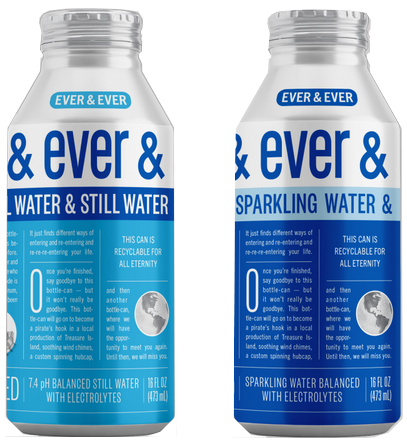
After decade and a half building its Vita Coco brand, All Market Inc is launching its first non-coconut entry, an aluminum-bottled still and sparkling water called Ever & Ever that’s positioned as sustainability play in concert with Lonely Whale, non-govt org with whom co partnered a year ago on longer-term sustainability initiatives. Lotsa intriguing threads to this one: it jumps in on increasing backlash to single-use plastic that has bottles being banned at corporate campuses, municipal airports and other closed foodservice systems where it’s easier to control issue (BBI, Apr 22). Also, in launching with unaligned house Big Geyser in NY, it represents rare move by Vita Coco outside longtime distribution partner Keurig Dr Pepper – move likely to be echoed in Aug when All Market launches its hemp-infused Vita Coco extension, at time big CPGs like KDP are still skittish about nascent category. (AMI hasn’t yet discussed launch strategy for hemp.) And Ever & Ever launch continues diversification push that commenced with acquisition of guayusa-based energy play Runa, which was recently restaged and entered distribution system of KDP. Tho AMI is working hard to ignite new burst of growth for core coconut water platform in stagnant category via such innovations as Pressed extension and canner sparklers, it’s made no secret of desire to become more diversified innovation player (BBI, Mar 11 and May 6).
According to cmo Jane Prior, Ever & Ever came to life in just 4 months starting in mid-Jan, as part of intensive effort with agency Interesting Development, whose role in new “Impossible to hate” campaign behind Pressed we just highlighted. Ever & Ever uses reverse-osmosis water sourced from municipal systems and is going out in Ball’s 16-oz Alumi Tek bottles for $1.99 each and in 12-packs at $23.99. Widemouth, resealable bottle offers text-heavy graphics treatment in keeping with intensive messaging behind launch, informing shoppers that “This can is recyclable for all eternity.” Note that it’s by no means first entry of this kind, joining other sustainability-driven aluminum-bottle water entries like Proud Source and Path Water (BBI, Oct 4 and Oct 31). Ever & Ever is launching at retail in NY first, via indie house Big Geyser, as well as on Amazon, with other indie houses aligned with Vita Coco such as Lenore in San Diego and Columbia in Pac NW likely to be next, along with broadliner UNFI. (Prior said going outside KDP-owned bottling system, as it has in NY, hasn’t been an issue, and KDP is sure to be part of network by time brand goes national early next year.) Ever & Ever will seek to herald new “movement” called Question How You Hydrate that seeks to present sustainable alternatives to single-use plastic water bottles. That campaign is being orchestrated by Point Break Foundation and its creative agency Young Hero. Multiserve bottle is being eyed for Ever & Ever down the road. Prior, a former Red Bull exec who joined All Market a decade ago and recently was elevated to cmo, said All Market anticipates that Ever & Ever will yield a meaningful revenue stream but stressed that it’s positioned as complement to, not substitute for, refillable bottles like S’well. Website is DrinkEverAndEver.com.
As for partner Lonely Whale, it recently had big impact in highlighting devastating impact that disposable plastic straws are inflicting on sea animals, leading to outcry that has straws being limited or even banned in various cities and corporations. Together, Lonely Whale and various corporate partners including All Market will further herald broad issue with opening this Sat of pop-up Museum of Plastic in NY’s Soho nabe, illustrating “an ocean free from plastic waste and the solutions available to everyday consumers to inspire action and make a positive impact.” Prior noted that All Market partnered with Lonely Whale a year ago to address its own role in propagating single-use bev packages, in process becoming more aware of aluminum’s sustainability benefits, including high recycling rates via well-developed infrastructure. So Ever & Ever represents in some ways an “ode to aluminum,” with plans to surround it with enough storytelling to get message across.
Tho there’s case to be made for using sourced water for premium launch like this, Prior said that brings its own sustainability burden, not to mention greater logistical challenge in getting the water to copack partner, so Vita Coco instead is describing water as deriving from “infinitely renewable sources” (meaning municipal systems). As for Vita Coco brand’s own heavy reliance on Tetra Pak packages, which bring sustainability challenges of their own, particularly in downstream phase, Prior said that was among reasons partnership with Lonely Whale was forged. So like many other bevcos, it’s moved this issue up the priority list, seeking creative solutions.
Even after massive Morinda deal, New Age Beverage isn’t done with acquisitions. Latest one announced this morning brings handful of partner brands that further burnish topline while adding some key infrastructure that can support NBEV’s existing brands: Brands Within Reach, the marketing, sales & distribution agency erected over past 16 years by Danone vet Olivier Sonnois. Among client brands that BWR brings under NBEV umbrella – in synch with Denver-based co’s strategy of being one-stop shop within fastest-growing bev categories – are bottled waters Volvic and Evian (the latter in natural channel) Nestea and Illy Coffee. Terms weren’t disclosed. BWR is based in NYC suburb of Mamaroneck.
Olivier this morning phrased the deal as providing “plug-&-play infrastructure” to NBEV org that some have described to us as somewhat threadbare, while providing BWR with access to working capital to more effectively grow its partner brands. BWR has played a key role in incubating brands such as British sparkling line Belvoir, which helped inaugurate elderflower flavor craze, and Go Go Squeeze apple sauce snack. Among others currently in fold are Found sparkling bevs, St-Geron bottled water and Kusmi Tea, along with range of natural snack brands. For NBEV, revenue stream from BWR brands should take topline handily above $320 mil run rate. It owns brands like multilevel marketing play Morinda along with packaged bev brands Xingtea, Marley and CocoLibre, and operates DSD arm New Age in Denver, among other activities. Barely a coupla years ago, NBEV ceo Brent Willis had started with just an underperforming kombucha co, Bucha, doing scarcely more than $1 mil in biz.
Sonnois, who grew up helping his distributor father deliver beer and bevs on Caribbean island of Guadeloupe, spent a decade at Danone and 3 years at Hain Celestial before heading into more entrepreneurial space via branding/sales agency originally called AMI Imports. Over years it’s become reliable partner to CPG players looking to resuscitate brands like Evian, Nestea and Illy that have been neglected as part of larger portfolio within cos like Coke and Nestle Waters.