



Beer Marketer's Insights
After all, as its cofounder/co-ceo Matt Roberts likes to point out, Cometeer invented a completely novel flash-freezing coffee tech and then built a factory in Boston to produce its unusual capsules, for shipment in dry ice to DTC customers. So why reinvent the wheel to get over another big hurdle: finding a way to merchandise the frozen items at retail?
That’s been at heart of recent activities by Cometeer to solve the conundrum of seeding at retail an initially DTC-oriented brand that lives in the freezer case, where those in the hunt for coffee are less likely to tread during their store visits. So it’s been ransacking ideas from brands like Freshpet, which has come to dominate the refrigerated pet-food biz after installing over 30K fridges in grocers’ pet food aisles. It’s been carefully monitoring progress in expanding test at Sprouts chain even as co undertakes significant revamp of packaging that was devised for DTC environment and has proved less than compelling at retail. As we’d reported last fall, Cometeer also debuted smaller pack of 4 units priced at $9.99 to escape the sticker shock that kept some shoppers from exploring concept with the pricier 8-packs. So far the various experiments are occurring at a small scale as the co pursues a mantra of “nail it, then scale it,” in Roberts’ words.
Cometeer, of course, has distinction of being most lavishly funded coffee startup in memory, to tune of $100 mil or more, at a time the rules of the game abruptly changed and that became a dubious distinction to some investors. Few have doubted the breakthru nature of process that yields “precision-brewed coffee with unrivaled flavor,” as one marketing slogan puts it, but scaling a frozen product that has a hefty communication burden and needs to be shipped with dry ice has brought its challenges, even as investors have grown more cautious about the cash burn. So the co has endured some exec change, including assignment of coo Matt Mandel as Roberts’ co-ceo, several rounds of layoffs and a scathing Forbes profile in Jan that, in truth, might have been written about dozens of other companies that are pivoting to adapt to these changed circumstances. (We outlined how one, Kitu Life Super Coffee, is adapting to the new reality just yesterday.) That was not a focus of our conversation with Matt this morning, and he addressed the topic just by saying that in earlier days “we were focused on the targets that the markets were focused on,” but are adapting now to new orientation. He said co boasts a healthy cash balance that avoids any need to go out for another raise.
Tho there’s been news coverage about Cometeer’s pivot to more financially sustainable strategy, not much has been written about its push to retail, the focus of our discussion today. Last we’d looked in on Cometeer last fall, staffers at Coffee Fest NY said it was planning its first foray into retail via a presence in the cutting-edge but compact Erewhon and Foxtrot Market chains with that new 4-unit pack (BBI, Oct 31).
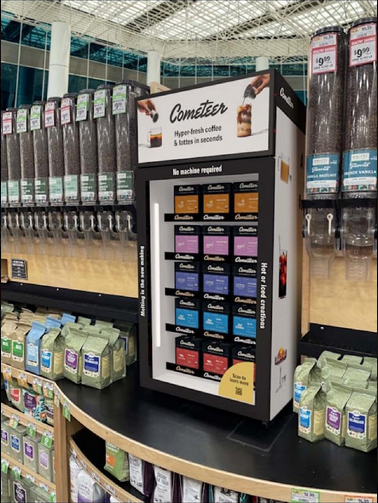
But the more crucial pilot, as it turns out, has been at about 10 Sprouts Farmers Market stores in Southern Calif, starting last Oct that’s now being expanded to 100 stores. In contrast to acquiescing with a freezer presence, mitigated with freezer door clings and in-store sampling, Cometeer has taken a cue from Freshpet by installing branded freezers right in the heart of the coffee section. Cometeer fortuitously was able to find units that were precisely the size of disused grinding machines placed among the whole-bean dispensers.
The freezers sports pair of messaging themes that emerged from focus groups and other research as crucial. First, some consumers would see the Cometeer capsule and assume a Keurig-like gadget was needed to use it. So machines sport slogan, “No machine required.” And with many consumers drinking their coffee exclusively hot or cold, Cometeer team realized they needed to make it explicit that the capsules serve both formats. Hence, “hot or iced creations” also went on the machines. Those messages will duly be imbued on the revamped 4-packs, tho their 4-inch-square size has forced some difficult discussions on messaging hierarchy. New look should emerge in coming quarter. While the $9.99 SRP for a 4-pk seems aggressive for coffee of that caliber, offered in partnership with respected roasters like George Howell and Joe Coffee, Roberts said keeping the price point accessible is crucial for generating trial. Once brand is more established, he expects it will be able to segment the retail offerings into various price tiers, just as is the case in the bagged coffee aisle.
As for Foxtrot and Erewhon, they’ve proved good hype-generating accounts, as anticipated – both among shoppers and other retailers who monitor their assortments. Cometeer also is just entering Central Market chain in Texas. Word on the street has been that a modest test may be commencing soon in Target, tho Matt demurred on commenting. And GoPuff has proved good partner, in part because brand can digitally tell its story there. On distribution side, Cometeer has just augmented its use of broadliners with addition of Rainforest refrigerated DSD house in NY. In keeping with resolve to pick its partners carefully, brand hasn’t settled on any key retail chains in its core Boston market as it continues to evaluate options, Matt indicated.
While Cometeer tries to refine its retail approach, things are moving forward on core biz. Its latest roaster recruit this week was Intelligentsia Coffee, a coveted partner, Matt said, because of the way it’s managed to maintain its strong commitment to direct trade with growers even as it’s scaled to considerable size. (It’s part of JAB-controlled JDE Peets, recall.) Its initial array includes a Burundi Yandaro offering that Roberts deemed one of best he’s ever had. To get some buzz going, Cometeer will be hosting free tastings starting Thurs at Intelligentsia coffee bars in NY, Boston, Chicago, Austin and LA. Intelligentsia joins array of respected roaster partners that include Counter Culture, Equator, Bird Rock and Onyx. Cometeer has been working with some of those partners on another gnarly challenge: how to get the frozen capsules to high-end customers at offices and hotels that may not even have refrigerators, let alone freezers. There’s a bit of wriggle room here: tho Cometeer coffees are best when consumed within 3-5 days, their actual shelf life can extend weeks, depending on the roast level. In this effort, Cometeer is looking to role models like the home delivery meals platform Once Upon a Farm.
Who’s Drinking RTDs?
The typical American RTD drinker is young, “with only 16% of drinkers being above age 55,” and comfortable financially, earning avg of $83K per year, found CGA’s On Premise User Survey (OPUS). RTD consumers split pretty evenly with 52% female drinkers and 48% males. While RTD bevs “are typically associated with Off Premise sales,” CGA called on premise “a critical avenue for adventurous consumers” to try them. Over past 3 mos, 17% reported consuming an RTD in bars/restaurants. Purchases “are primarily motivated by the variety” of flavors, cited by 28%. Interesting that CGA found “health considerations” don’t play an important role in consumer decision-making on RTDs. Only 20% of consumers considered alc content and “only a minority” were “concerned with calories,” per survey.
Gallo is at it again. Top US vintner E&J Gallo announced its 3rd acquisition in less than 2 months, this time expanding its premium wine portfolio with purchase of Hahn Family Wines. “Strategic investment” includes Smith & Hook, Hahn, and Hahn SLH brands, tho financial terms weren’t disclosed and transaction “excludes the Hahn family’s vineyard assets,” per release. Those wines line up in Gallo’s more traditional lane, whereas last 2 bolt-ons were both canned offerings in form of Bev wine brand and Fishers Island spirits-based RTDs. Yet Gallo is clearly getting more acquisitive and already owns top spirits-based seltzer High Noon. Will Gallo continue to add to this buying spree?
The time to put “Beer First” and use its proprietary category-wide sales assets is now, NBWA told members today. “Considering the recent unprecedented media coverage of the beer industry, it has never been more important to invest in promoting the beer category and its strength in the market,” leads off note from prexy/ceo Craig Purser highlighting org’s Beer First Initiative. “2023 year-to-date April industry supply trends are the worst they have been in recent history,” note continues. Tho brands left unnamed, it references “significant challenges” for some “creating opportunities for others.” But this may be inflection point for brand beer, too. “The entire beer category is at risk as consumers make different choices,” org highlights in bold.
Recall, Beer First Initiative involves broad set of assets designed to help distribs highlight strength of entire beer category on sales calls. Email today offers members an easy first-time login to access and get used to the initiative’s key components, like category-specific and customizable sell sheets and profit calculators for both on- and off-premise. Initiative also includes assets for hosting on-premise events and public-facing @beerstothat Instagram account. NBWA aims to launch additional resources to help distribs play up beer’s positives in coming wks, it hinted.
Speaking to CO beer distribs last week, NBWA chief economist Lester Jones portrayed thru mountains of charts and data a beer industry that’s overall healthier and more stable than it has appeared just lately. And yet… volume is soft so far in 2023, he acknowledged. Lester has tracked 12-mo moving avg for over a decade and the 12-yr CAGR for the beer biz is -0.3%. However, first 4 mos of 2023 data (domestic taxpaid + imports) “show a very significant volume drop,” according to Lester. And remember the industry fell more than 3% last yr (for first time over 50 yrs). So fact that it’s soft again this yr is a concern.
Alc Bev Expenditures Still Rising; Per Caps, % Who Drink Stay Roughly Same People continue to spend lotsa money on alc bevs and those expenditures remain “recession resilient,” Lester said. In fact, they have steadily climbed from 1940-2022, hitting $183 bil in 2022, according to US govt stats. And over last 30 yrs, alcohol spending almost always between 0.8 and 1% of total consumer expenditures, Lester showed. It dipped during pandemic because of “drop off in on-premise spending,” Lester said, but still 0.8%.
The % of adults who “have occasion to drink alcohol” stayed remarkably consistent over time, according to Gallup polls, as Lester showed. But “lines are blurring” and consumers’ preferences are changing away from beer and towards spirits. Still, the amount of absolute alcohol consumed has stayed very close to the same 2.5 gallons per person over the last couple of decades. Rising slightly above in 2021-2022. Remains to be seen if that will stick. Indeed “current trends are unsustainable,” according to Lester and “either volumes or ABVs have got to give.” Or else population needs to grow faster.
Draft Growth Is “Missing Link” for Industry Recovery One reason why beer volume softer last 1.5 yrs is because on-premise biz, especially draft, has not come all the way back to pre-Covid levels. Whereas draft used to be over 10% of the biz, it dropped down to 6% in 2020, recovered to 8% in 2021 and 8.5% in 2022. Meanwhile, brewpub bbls (mainly taprooms) grew rapidly in 2021 and flattened out in 2022 at 4.5 mil bbls and are now 3% of domestic beer volume.
Twisted Tea family sales accelerated to +40% in May scans, in large part due to sizable success of the Twisted Tea Party Pk. Indeed, Twisted Tea Party Pk $$ grew 181% to $21.6 mil total for 4 wks thru May 28 in Circana MULC data. That $13.9-mil gain was 4th largest among all beer brands in May. Only Coors Light (+25%, $48 mil), Modelo Especial (+15.6%, $45 mil), and Miller Lite (+21.5%, $38 mil) gained more $$ for period. Party Pk became Twisted Tea’s #2 brand for 4 wks even as Half & Half kept up 25% growth pace. It was #26 beer brand overall by $$ for 4 wks, ahead of Corona Premier and Bud Ice. Not too far behind Corona Familiar and Blue Moon Belgian White. Flagship Twisted Tea Original grew 14% for 4 wks and remains #11 beer brand by $$ in Circana MULC channels YTD.
Momentous shift in beer volume over the last few yrs led to Texas snatching spot as new #1 state for beer volume, according to Beer Institute estimates. TX dipped just slightly to 21.3 mil bbls in 2022 vs 2021 while CA slipped another 2.7%, 590K bbls to 21.1 mil bbls, BI figures. And TX is pulling away in early 2023 after particularly soft start for CA amid tuff weather, as execs from each of the top beer suppliers mentioned separately. TX is up nearly 2% to 6.77 mil bbls thru Apr 2023 vs year ago while CA dropped nearly 8% to 6.2 mil bbls, BI estimates.
Combo of Covid-19 disruptions, population shifts, and various other competitive and climate factors led to CA volume declining 8.7%, 2 mil bbls in 2022 vs 2019, including steep 5.7% drop in 2021 vs 2020. On the other hand, TX volume surged 5%, 1 mil bbls in 2020 vs 2019, and only lost slight volume since. So net-net, TX beer volume grew 4%, 845K bbls from 2019 to 2022, per BI.
Gotta note, total TX population grew by 1 mil to 30 mil since 2019, while total CA population dipped below 2019 peak of 39.4 mil. So TX 21+ population still 7.6 mil below CA in 2022, based on Census Bureau estimates. Means that avg Texan adult drank 40% more beer than the avg Californian. At about a bbl per 21+ adult per yr, avg beer consumption in TX is about 6.4 12oz beers per wk vs just 4.8 in CA.
Dive much deeper into these state-level stats and much more with our annual compendium of beer biz data, Beer Industry Update. This yr’s edition will be available next wk! Save $150 and order your copy today.
One of Seattle’s up-and-comers plans to get a lot closer to downtown and go toe-to-toe with brewpubs owned by much bigger brewers. Stoup Brewing will take over the sprawling Capitol Hill location of Optimism Brewing, the nabe’s community news blog reported. Optimism co-founders Troy Hakala and Gay Gilmore will retain ownership of the prime real estate as Stoup picks up the equipment and replaces Optimism branding and beers. Deal not expected to close til later this summer. In meantime, owners of both cos intend to allow Optimism employees to make their own decisions about staying on or not. But when all is said and done, Stoup expects to employ about 80 across its 3 locations.
Stoup rebounded strongly last yr, recovering all of the volume it lost in 2021 and then some, topping 5,300 bbls, according to Brewers Assn estimates. Optimism also came back strong last yr, building back to around 1,200 bbls, co reported to BA, tho not quite back to the 1,600 it produced in 2020. Still, its 16K sq-ft location with a 20-bbl brewhouse offers Stoup some more brewing capacity in addition to a large taproom in a high-traffic neighborhood. Location is just a few blocks from a pair of AB-owned breweries, both Elysian’s Capitol Hill Brewery and the Redhook Brewlabs spot. Stoup’s first location is in the brewery-dense Ballard nabe. Co opened a taproom and kitchen in Kenmore, just outside Seattle in 2021. Just over a year ago, Stoup teamed with Portland, OR’s craft-centric Day One Distribution to begin a distribution arm.
New York-based Sarene Craft Beer Distributors crossed into its 6th state this mo after acquiring Cincinnati-based Adena Distributing, Cincy Biz Courier reported. Sarene operates in NY, NJ, CT, RI and PA, according to its website, selling around 800K cases across its broad footprint, co told the paper. Adena is much smaller, opened in 2018 by Michael Amann, who abandoned plans of opening a brewery in favor a small craft-focused distributorship. Deal closed June 5 with undisclosed terms, per paper.
Sarene will take on Adena’s brands, tho co already works with a handful of the same craft brands in at least part of its existing territory, including IL’s Pipeworks and NY’s Singlecut, among others. Sarene likely to bring other brands into OH for first time. “It seemed like they had their stuff together and they had brands that people were looking for in Ohio,” Michael said. Indeed, deal “offered us an opportunity to kind of hit the ground running a lot faster,” co-owner Matthew Schulman said. Co aims to double the OH biz in 1st yr, taking on Adena’s 4-person workforce and operating out of 2 warehouses in Cincy and Columbus. Adena founder Michael will take on an ownership stake in Sarene, joining co’s 4 existing owners.
While deal for Flying Fish Brewing ultimately didn’t happen (see Jun 14 issue), Cape May Brewing is already onto the next thing. Here comes Cape May Spirits Co, a sister co to Cape May Brewing, debuting Beach Blends canned cocktails line with “all-natural juice, premium vodka and sparkling water,” starting with Tropical Vodka Punch and Orange Vodka Crush flavors. Beach Blends clock in at sessionable 5% ABV, sold in 4pk 12oz cans, available thruout NJ starting Jun 20 (today) and distributed via its own Cape Beverage Distributing. This was “in the works for a long time,” and marks “part of the next chapter of our organization,” CEO Ryan Krill shared in released statement. “Combined” with Cape May Brewing’s “presence” and Cape Beverage’s growing portfolio, “the three companies will keep our fans and customers excited and eager for what’s to come – regardless of what craft beverage they choose to enjoy,” he continued.
Recall, this is Cape May’s latest exploration beyond beer. Co launched hard seltzer but ultimately pulled its distribution this yr as sales declined sharply. It also planned to launch Cape May Hard Iced Tea after separately collaborating with Wawa to create Shore Tea. And co’s bringing back Cape May Hard Lemonade after successful debut last summer.